
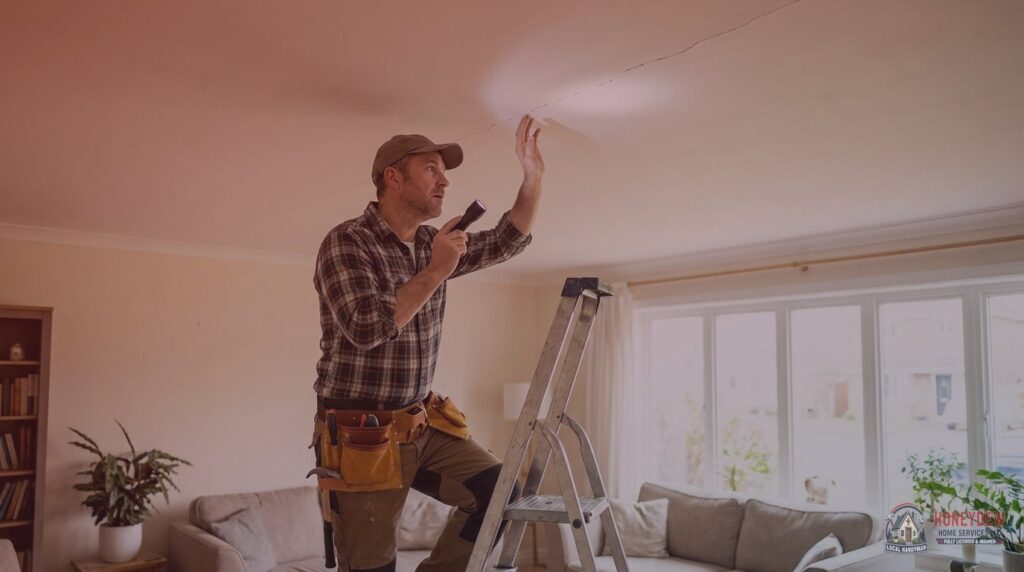
Ceiling cracks signal specific structural, moisture, or settling conditions in a residential home, and each cause determines how the repair must be done. A hairline seam crack from normal settling needs different treatment than a sagging crack caused by water damage or foundation movement. Kenny Neville’s licensed handyman team in Middle Georgia identifies the root cause before touching the surface, then repairs the crack so the fix holds long-term.
What causes cracks in a ceiling?
Ceiling cracks have four common causes: failed drywall tape joints and minor house settling produce hairline seam cracks, foundation settlement or truss uplift produces diagonal or stair-step cracks, layered old paint or plaster shrinkage produces spider-web cracking, and structural movement or water damage produces wide or sagging cracks.
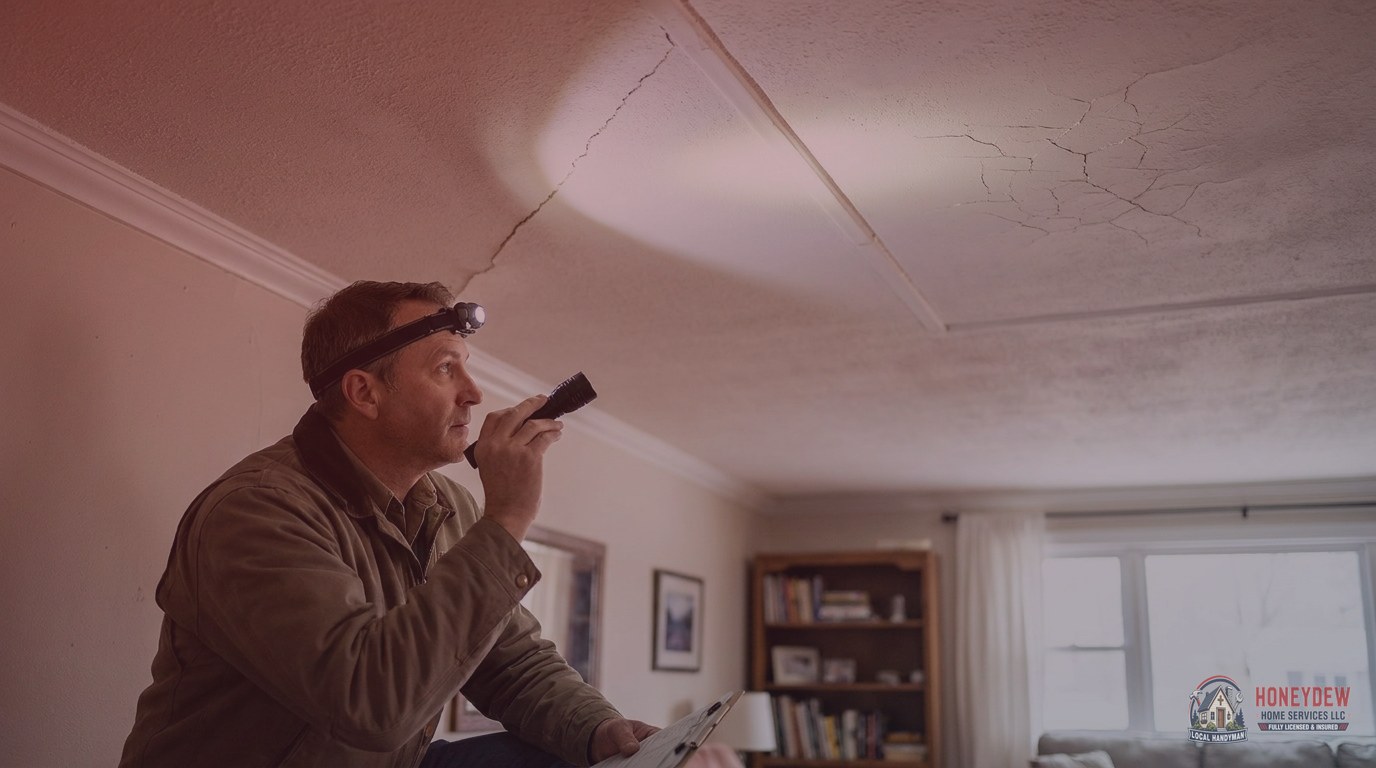
A ceiling crack’s appearance indicates a specific underlying cause that must be identified before repair begins, because the correct fix depends entirely on which cause produced the crack.
Hairline ceiling cracks are caused by normal drywall joint settling and minor house movement, not structural failure. These thin, straight cracks run along drywall seams where the joint tape has lost adhesion, and they are cosmetic rather than a sign of trouble.
Diagonal or stair-step ceiling cracks are caused by foundation settlement or truss uplift and require evaluation before cosmetic repair. In Middle Georgia, settlement frequently traces back to the region’s expansive clay soil, a process explained in how clay soil shifts foundations. Truss uplift is common in Middle Georgia homes due to seasonal humidity swings that expand and contract roof framing. According to Maybee Inspections, the top chord of a truss expands while the bottom chord contracts as humidity changes, the truss lifts at its center, and a crack opens at the wall and ceiling juncture, typically becoming visible in winter. ThisIsDrywall.com notes that these juncture cracks open in winter and close in summer, and Truss Components of Washington reports that poor attic ventilation traps humidity rising from the living space below and worsens the seasonal movement.
Spider-web cracking, also called alligator cracking, shows up as a network of fine intersecting lines. Multiple layers of old paint or shrinkage in original plaster causes this pattern, and like seam cracks, spider-web cracking is cosmetic.
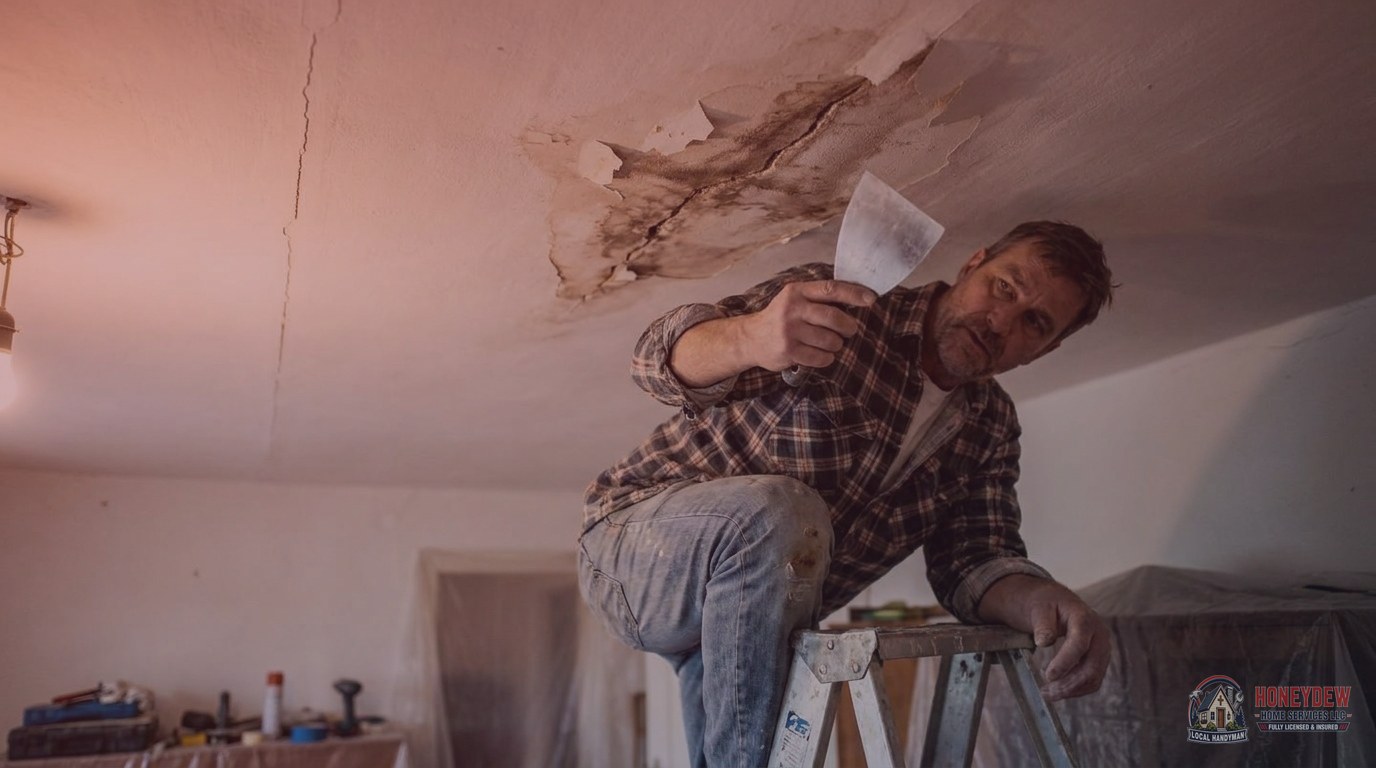
Wide or sagging cracks are the one scenario that demands caution before any cosmetic work. A gaping crack, a sagging section of drywall, or cracking paired with brown staining points to structural movement or an active water leak, and that underlying problem must be resolved first.
Crack geometry is a more reliable severity indicator than crack width alone. Direction and pattern tell the real story: a long diagonal crack running from a ceiling corner toward a window typically signals foundation settlement or truss uplift, while a straight crack running along a drywall seam is almost always a failed tape joint and purely cosmetic. A wide seam crack is still cosmetic, and a hairline diagonal crack still warrants evaluation. Homeowners often treat every crack as equally urgent or equally trivial, but the shape is what separates a simple retaping job from a call for an inspection.
When is a ceiling crack a serious problem vs. a cosmetic issue?
Cosmetic ceiling cracks run hairline-thin along straight seam lines with no displacement between the crack edges and no sagging anywhere in the ceiling. Serious ceiling cracks exceed ¼ inch in width, show water staining, or appear alongside a sagging or bulging section or one edge sitting higher than the other.
| Cosmetic signs (safe to patch) | Warning signs (professional evaluation before repair) |
|---|---|
| Hairline width | Wider than ¼ inch |
| Straight seam-line location | Water staining along the crack |
| No displacement between crack edges | One edge sits higher than the other |
| No sagging in the surrounding ceiling | Sagging or bulging on either side of the crack |
Wide or sagging ceiling cracks indicate potential structural concern or water damage that must be resolved before patching. When a crack comes with soft, discolored, or crumbling drywall, the repair scope shifts to water-damaged drywall replacement, covered in Water-Damaged Drywall Repair.
One common Georgia cause falls between cosmetic and serious. Truss uplift produces many ceiling-to-wall-junction cracks in Middle Georgia homes, and Truss Components of Washington (2023) classifies truss uplift as a cosmetic issue rather than a structural defect, tracing the cause to seasonal moisture changes in wood roof framing. The crack is no emergency, but a standard patch will not hold: the repair must use a method built for seasonal movement, or the crack reopens. Professional Roofing, the National Roofing Contractors Association magazine, reported in 2008 that few methods completely eliminate truss uplift, while proper moisture management significantly lessens its effects.
How is a ceiling crack professionally repaired?
Professional ceiling crack repair follows a sequence of cause identification, surface preparation, mesh or tape reinforcement, joint compound application, sanding, priming, and texture matching, with each step building a patch that bonds to solid drywall and resists reopening under seasonal movement. Kenny Neville offers ceiling crack repair as part of his local licensed residential drywall repair services. The drywall crack and ceiling repair work Kenny Neville performs across Middle Georgia applies the sequence to cosmetic joint failures and symptom-driven cracks.
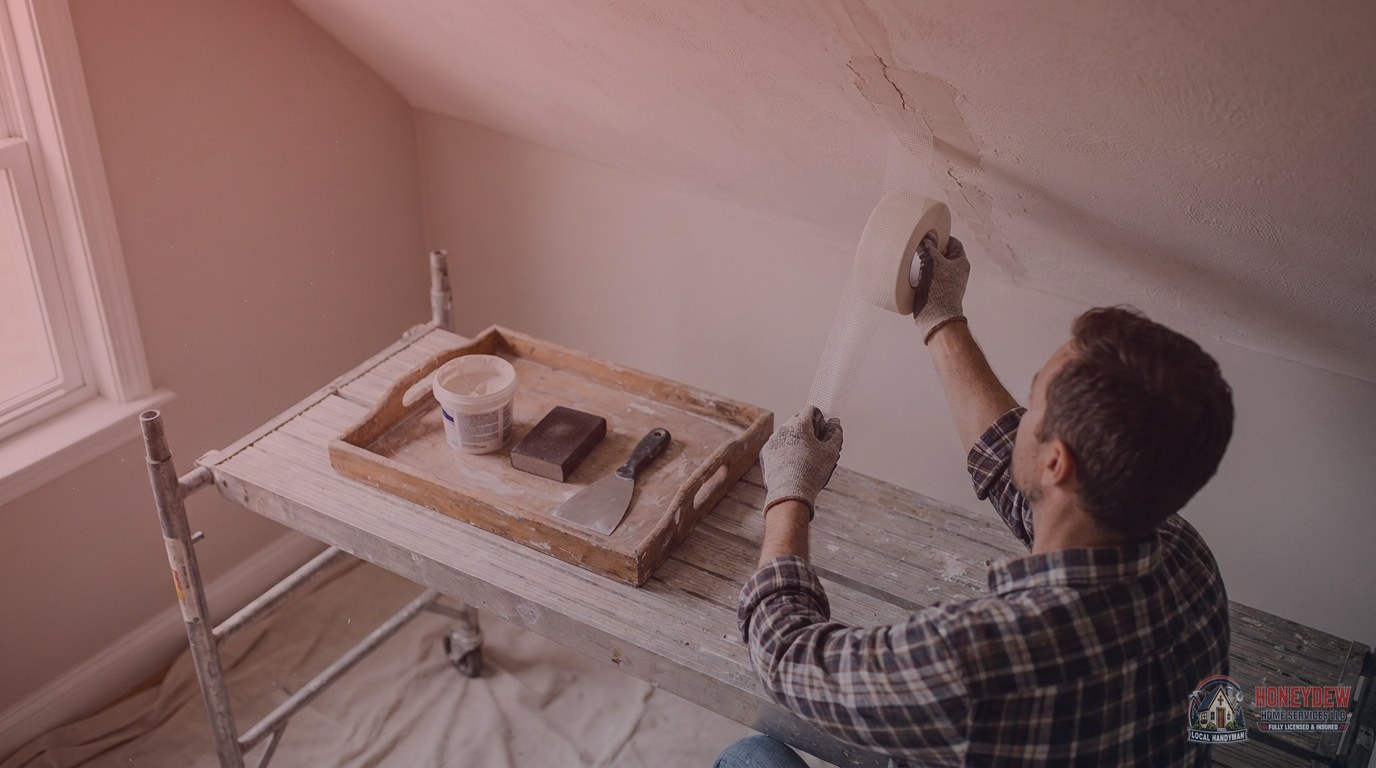
1. Cause identification. The technician determines whether the ceiling crack is cosmetic, like a failed tape joint or ordinary settling, or symptom-driven by active truss uplift or moisture, before touching the surface. A correct diagnosis keeps the homeowner from paying for the ceiling crack repair twice. 2. Surface preparation. The technician widens the crack slightly, cleans out loose debris, and removes failing tape or compound so new material bonds to solid drywall. 3. Reinforcement. Self-adhesive fiberglass mesh tape or paper tape reinforces any crack longer than a few inches and keeps the patch from splitting along the original crack line. 4. Joint compound. The technician applies joint compound in thin coats, feathers the edges of every coat, and allows full drying time between coats. 5. Sand, prime, and texture. The technician sands the patch smooth, seals the compound with a moisture-resistant primer, and matches the ceiling texture before painting.
For active truss uplift, the correct fix is a floating corner detail: the technician does not fasten the ceiling drywall to the top plate near the corner, so the truss moves seasonally without tearing the joint. Maybee Inspections reports that homeowners who fill truss-uplift cracks with drywall compound see the cracks reappear the following year, an outcome generic DIY guides almost never warn about.
In Middle Georgia’s high humidity, an unpainted or under-primed patch absorbs moisture and develops micro-cracks within months. A moisture-resistant primer under the finish paint separates a durable repair from a cosmetic patch that fails by the next summer.
Popcorn and textured ceilings add complexity because the technician must recreate the original texture across the patch for the repair to disappear, and textured drywall matching handles that final blend.