
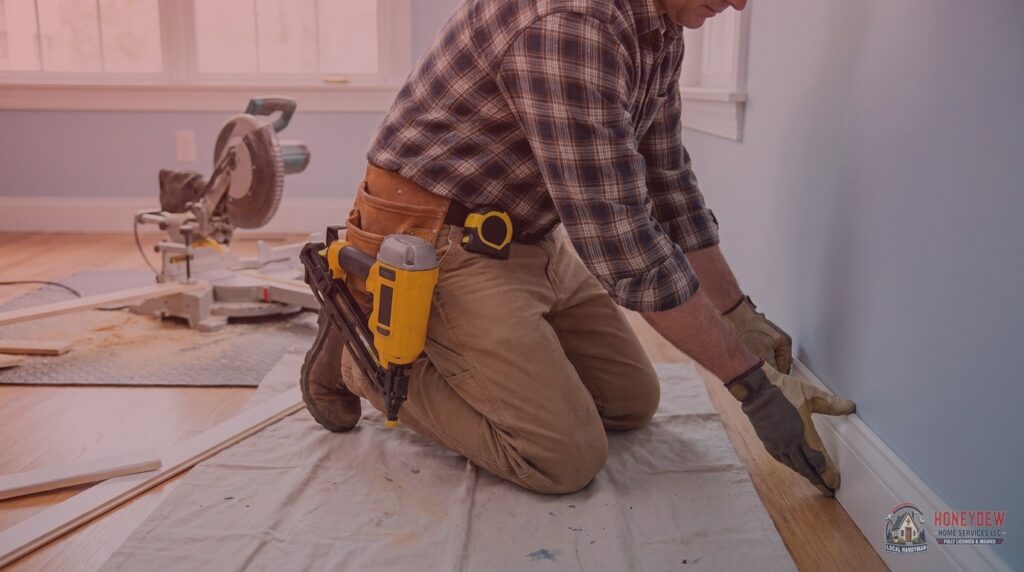
Kenny Neville provides licensed residential handyman services for trim, molding, and baseboard installation, repair, and replacement in Georgia homes. Trim work requires precise miter cuts, accurate profile matching, and finish carpentry skill that separates a licensed handyman from a DIY patch job. Kenny Neville delivers crown molding, baseboards, chair rail, and door and window casing repairs that look factory-original. Georgia homeowners get clean, matched trim work without hiring a full-scale remodeling contractor.
What trim, molding, and baseboard services does Kenny Neville provide?
Kenny Neville provides licensed residential trim, molding, and baseboard repair and installation in Georgia, covering crown molding, baseboards, chair rail, door casing, and window casing in Locust Grove, Hampton, and surrounding communities, from new installation to repair of damaged sections.
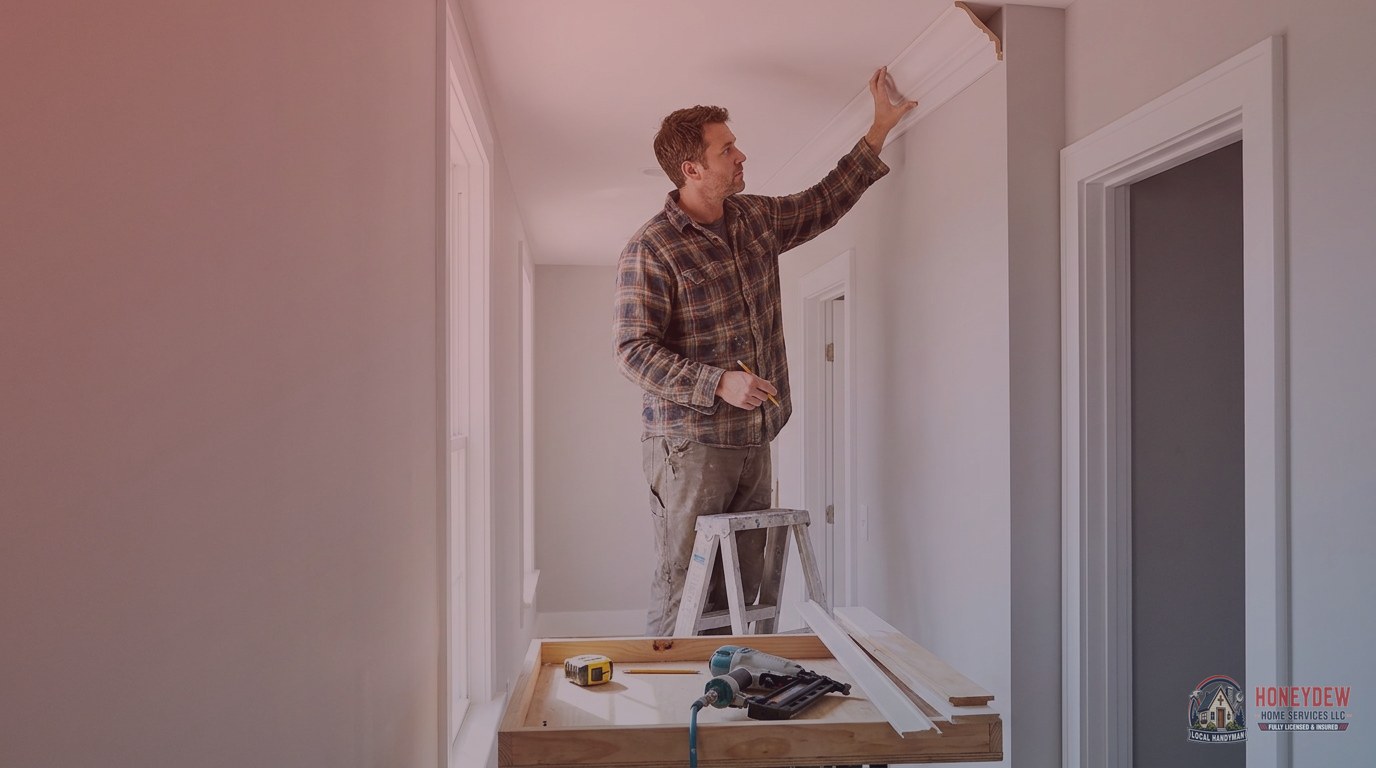
Kenny Neville works as a licensed handyman. Kenny Neville integrates finish carpentry into a broader home repair capability rather than offering trim work as a stand-alone specialty. A homeowner who books trim work hires one accountable professional who can also handle the surrounding interior finish repair services a room needs, instead of scheduling a separate carpenter for a small molding job.
Installation work covers new trim in finished rooms and upgrades to existing profiles. Homeowners planning trim and molding upgrades that add value typically start with crown molding, taller baseboards, or fresh casing around high-traffic doorways. Repair work covers the other side of the scope: Kenny Neville resecures loose pieces, patches damaged spots, and replaces missing sections with matching profiles so repaired runs blend into the original trim.
Door and window casing repairs sit inside that scope. Kenny Neville reattaches casing that has pulled away from the jamb, re-cuts cracked miter corners, and replaces missing casing sections, and homeowners commonly bundle casing fixes with door repair visits. Because crisp, gap-free trim changes how a whole room reads, Kenny Neville performs trim and casing repairs that rank among the highest-value repairs in Middle Georgia, and homeowners gain a cleaner, more finished room from each repaired run.
What does crown molding and chair rail installation involve?
Crown molding installation mounts angled trim at the ceiling-wall junction and requires precise miter cuts and ceiling-angle compensation to produce seamless corner joints. Chair rail installation applies to dining rooms, hallways, and stairwells as both decorative and wall-protection trim. Both trim types raise perceived finish quality and resale value.
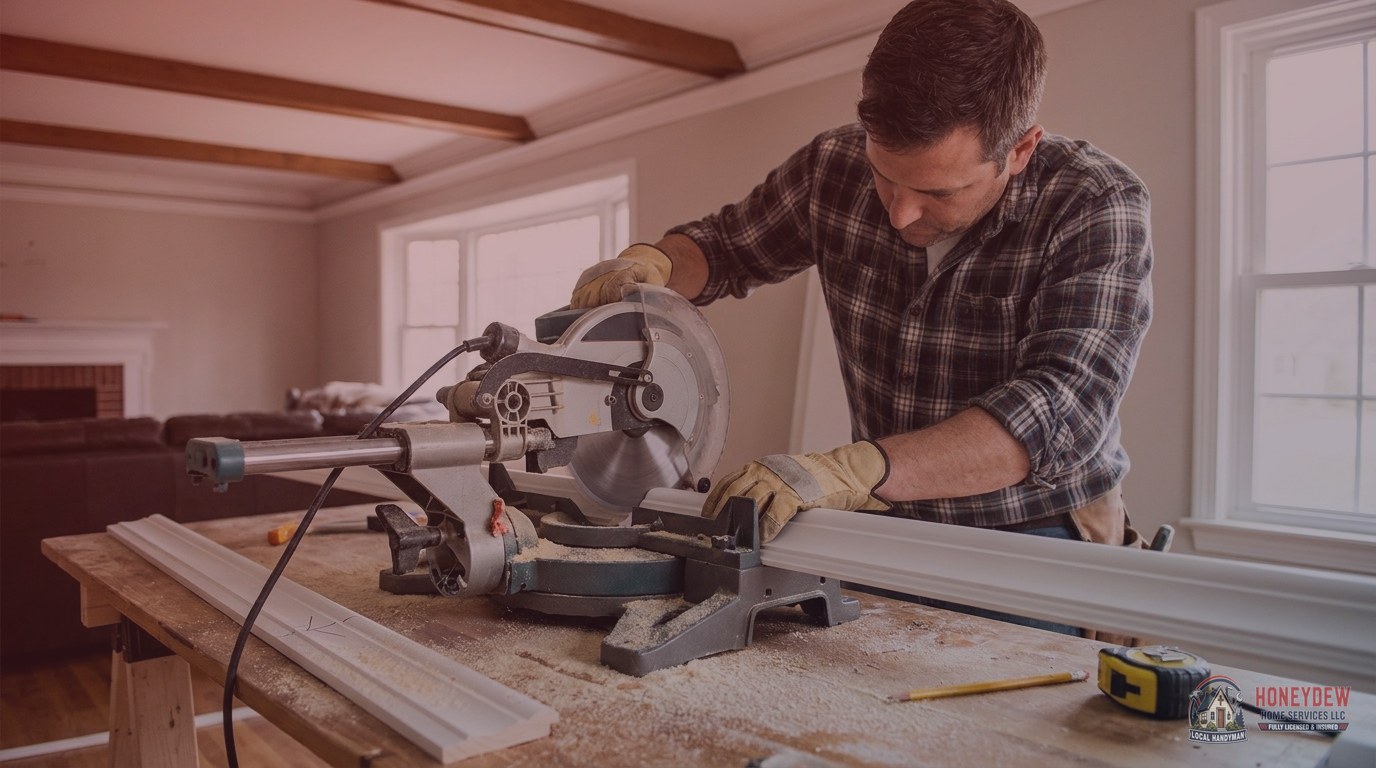
Crown molding is not a flat-cut job: the trim bridges wall and ceiling at a fixed spring angle, so installers measure every wall and record the actual corner angles, since ceilings in older Georgia homes are rarely flat or square. The miter saw holds each piece at the molding’s spring angle so every cut matches how the trim sits on the wall, and installers cope the inside corners while cutting the outside corners to the measured angles rather than a standard 45-degree miter. Fasteners anchor the molding to studs and ceiling joists, and caulk and wood filler close each joint. Most DIY crown installations fail at the corners because a 45-degree miter assumes a perfectly square corner: the out-of-square ceiling itself causes the corner gap, and seasonal humidity movement makes that gap worsen over time.
Chair rail follows simpler geometry. According to diyproject.ai, chair rail mounts approximately 32 to 36 inches from the floor, roughly one-third of wall height; the trim originally protected plaster walls from chair backs, and modern installations use chair rail as a visual break between paint colors or wallpaper zones. Homeowners in Hampton, GA request chair rail upgrades often in older colonial and craftsman-style houses, and the chair rail installation in Hampton provides a geo-specific overview of local projects. The crown molding installation cost and timeline covers local pricing and scheduling for crown molding projects.
When Should Damaged Baseboards Be Repaired Versus Fully Replaced?
Repair damaged baseboards when the damage stays cosmetic: surface dings, small splits, and bubbling paint respond to filling, sanding, and refinishing. Replace baseboards fully when the wood rots, warps, or pulls entirely away from the wall, because patching cannot restore structural integrity.
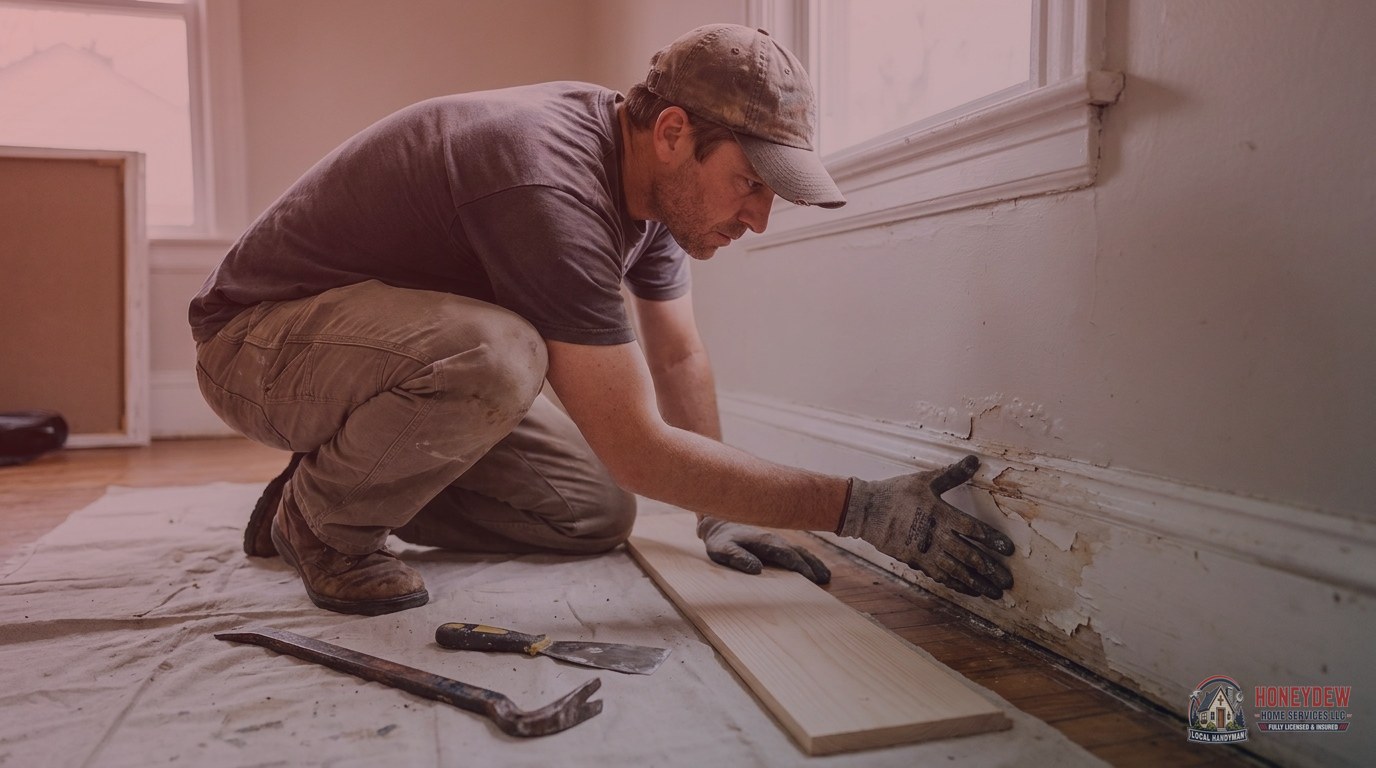
Baseboard repair is decided by the extent of damage: splits and dings get repaired, while rot, warping, or missing sections require full replacement.
| Damage condition | Decision |
|---|---|
| Surface dings, scratches, small splits | Repair and refinish |
| Bubbling or peeling paint over firm wood | Repair and refinish |
| Soft, spongy substrate (rot) | Full replacement |
| Warped or bowed boards | Full replacement |
| Sections missing or pulled entirely away from the wall | Full replacement |
Water-damaged baseboards deserve a probe before any decision. Water-damaged trim is assessed by probing for soft wood and checking for mold before determining salvageability. Press a screwdriver into the suspect board; the screwdriver test takes seconds and reveals whether the substrate is still structurally sound and paintable. Bubbled paint over firm wood needs only sanding and repainting, and that judgment call determines which water-damaged trim can be saved. Homeowners frequently pay for full replacement when only the paint surface failed, so the probe can save the entire replacement cost.
In Georgia’s humid climate, seasonal wood movement causes most baseboard separation from the wall rather than installation failure, and re-nailing plus caulking resolves most cases without replacement.
The baseboard repair in Locust Grove covers how each damaged board gets assessed on site before repair or replacement begins. The wall repair beneath trim and baseboards covers the drywall patching and repainting that full replacement can expose.
How does a handyman match new trim to existing molding profiles?
A handyman matches new trim to existing molding by tracing the old profile with a profile gauge or pulling a sample piece, then sourcing matching stock through millwork suppliers or custom routing when big-box stores no longer carry the pattern.
The profile gauge records the cross-section of the existing door and window casing or baseboard, and the handyman compares the traced contour against molding catalogs to confirm the exact pattern before ordering material. Profiles in many older Georgia homes are no longer stocked at big-box stores, so the match comes from a millwork supplier, and discontinued historic patterns require custom routing that reproduces the original cross-section. According to This Old House, walls and ceilings in older homes frequently deviate from 90 degrees at the corners, so the installer measures each actual angle rather than assuming a standard 45-degree miter cut.
Profile matching is required for partial trim repairs so that new sections of door and window casing are visually indistinguishable from the existing molding. A mismatched profile is the most visible sign of an amateur repair and reduces the value of the work. Matching a profile is a skill constraint, not only a sourcing task: a DIYer typically installs the closest big-box approximation, while a licensed handyman specializes in sourcing molding that blends seamlessly through millwork channels and custom routing.