
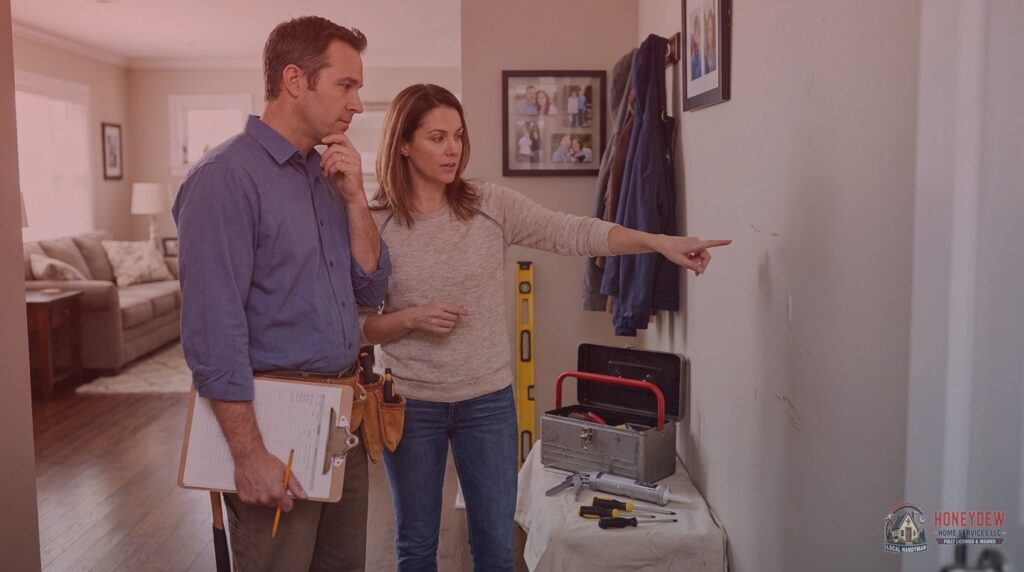
Locust Grove homeowners are choosing a licensed handyman over separate trade specialists for everyday home repairs. One scheduled visit from a handyman closes several punch-list items at once, saving time, cutting coordination overhead, and avoiding the stacked service minimums that each specialist charges separately. Henry County’s growth keeps family schedules tight and home to-do lists long, and a licensed handyman fits that pace better than three separate contractor appointments.
Why are Locust Grove homeowners choosing a handyman over calling multiple specialists?
Locust Grove homeowners choose a licensed handyman because one appointment finishes several unrelated repairs at once. Rapid new-home construction across Henry County produces long, mixed punch lists of small tasks, and a single handyman visit replaces separate calls to a plumber, an electrician, and a carpenter.
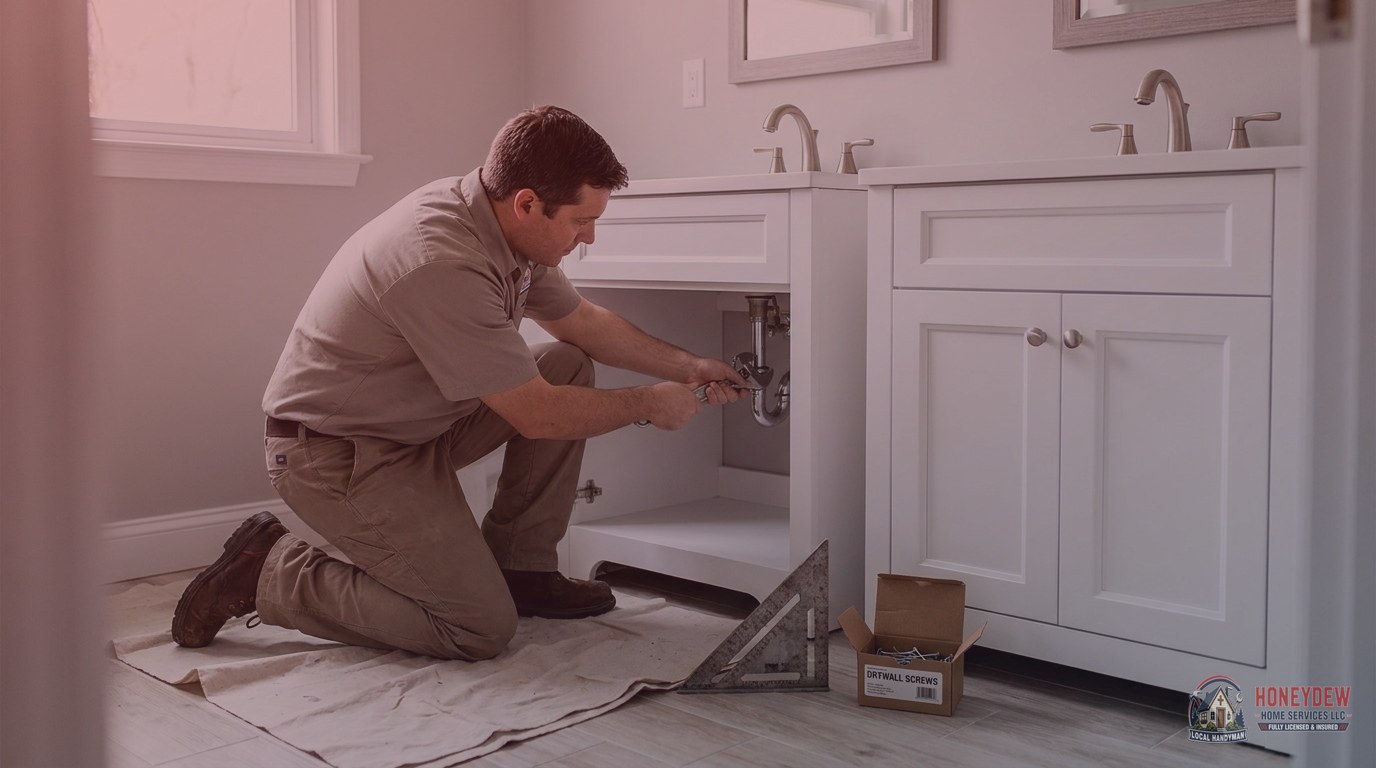
Locust Grove residential growth creates a high volume of mixed small-to-medium repair needs in newer homes. According to a 2026 MyTownView report, Locust Grove issued 215 residential building permits in 2024, all single-family homes, a 5.4% increase over the prior year and 212% above the Henry County average of 69 units per city. The City of Locust Grove states that Locust Grove, Hampton, McDonough, and Stockbridge lead the county in new home construction. New households accumulate drywall touch-ups, fixture swaps, door adjustments, and caulking work within the first years of ownership, and a mixed list of small repair tasks suits one handyman visit.
A licensed handyman completes multiple unrelated repair tasks in a single visit, so one scheduling window closes every line item at once. The scope of what Locust Grove handymen actually handle spans drywall repair, fixture replacement, door adjustment, and caulking in the same appointment. Coordinating specialists runs the opposite way: each trade keeps a separate call window, a separate trip fee, and often a separate day off work for the homeowner, and completions stagger across days or weeks. One handyman appointment ends the coordination runaround.
Locust Grove’s newest housing stock shows the handyman advantage most clearly. Owners of Locust Grove homes under five years old accumulate warranty-era punch lists of cosmetic and minor mechanical tasks at high frequency: drywall nail pops, caulking failures, door adjustments, and fixture swaps. Homeowners unfamiliar with trade scope boundaries misroute warranty-era punch lists to specialists, phoning an electrician for a light fixture, a drywall contractor for nail pops, and a carpenter for a sticking door. Every task on a warranty-era punch list falls within handyman scope, so misrouting turns one afternoon of handyman work into three service minimums and three separate schedules.
How much does calling separate specialists actually cost compared to hiring a handyman?
Calling three separate specialists for three small jobs typically costs $225 to $450 in stacked trip fees and service minimums before any repair work begins, while a licensed handyman completes all three tasks under one consolidated visit charge.

The cost advantage comes from eliminating duplicate trip fees rather than from a lower hourly rate. Specialty contractors charge a separate service minimum or trip fee for each trade visit, usually $75 to $150 regardless of how small the task is, so a homeowner booking three trades pays three minimum charges before a single tool comes out.
Cost data published by Ainora.lt in 2026 shows how those charges stack on a typical Locust Grove punch list:
1. Plumber: a trip or diagnostic charge of $45 to $200, with typical repairs adding $175 to $450. 2. Electrician: a diagnostic of $50 to $100, with typical repairs running $160 to $560. 3. HVAC technician: a diagnostic charge of $75 to $200 before any repair work begins.
A licensed handyman bills every task on the list under one visit charge, so the homeowner pays for a single trip instead of three.
The schedule carries a second cost. Scheduling multiple specialists requires separate appointment windows, coordination time, and extended project timelines. Henry County’s rapid residential growth keeps individual trade specialists booked well in advance, and each trade’s lead time can stretch the project by days or weeks. A handyman clears the full list in one scheduled visit.
What work actually requires a licensed specialist instead of a handyman in Georgia?
Georgia law requires a licensed trade contractor for any job that legally needs a trade permit: electrical panel replacement, gas line installation, HVAC system changeouts, and plumbing rough-in. A handyman cannot pull trade permits in Georgia, so the deciding line is the permit requirement, not task difficulty.
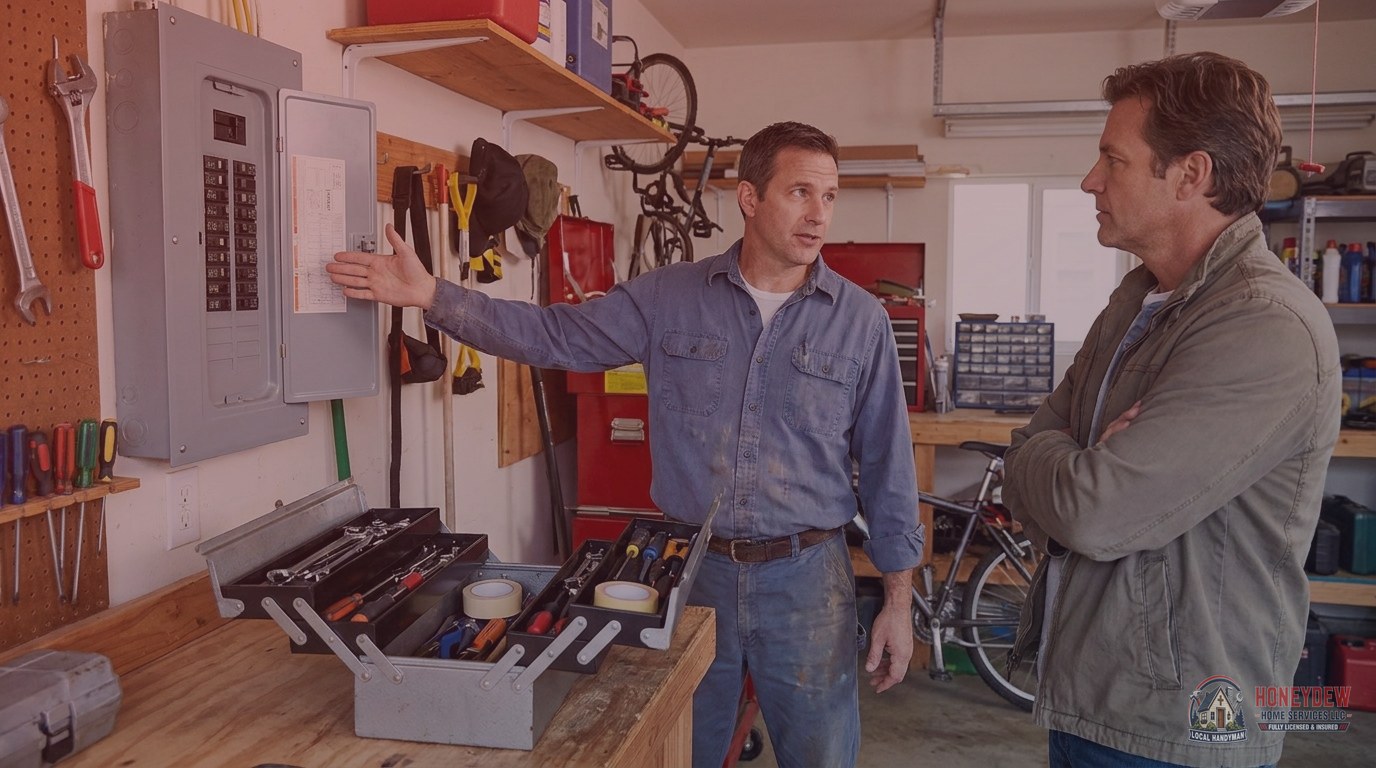
Under Georgia Code § 43-14-8, no person may engage in the electrical contracting business without a valid license and certificate of competency, according to Justia (2024). Permitmetric (2026) reports that all plumbing work in Georgia requires a licensed plumber under the Georgia State Plumbing Contractors Licensing Board. Adapt Digital Solutions (2026) confirms that specialty trades such as electrical, plumbing, HVAC, and low-voltage work require a state license at any project value. In practical terms, Handyman scope of work excludes licensed trade work such as full electrical panel replacement, HVAC system installation, and permitted plumbing rough-in.
That rule is legal, not personal. A handyman may have the skill to swap a panel, but Georgia reserves the work for license holders because permitted jobs trigger inspection. Plenty of tasks only look like specialist work. Replacing a light fixture, swapping a faucet, patching drywall, and installing a ceiling fan on existing wiring all sit comfortably inside handyman scope. HowToStartABusinessGeorgia.com draws the line clearly: replacing a faucet handle is generally permissible, but cutting into supply or drain lines is not for unlicensed individuals.
Sometimes a job changes midstream. If a faucet swap uncovers corroded supply lines that require permitted plumbing, the right handyman stops and brings in a licensed plumber rather than pushing past the legal line. A handyman who respects that boundary is showing good judgment, not limited ability.
How does Kenny Neville handle multi-task repairs for Locust Grove homeowners in one visit?
Kenny Neville serves Locust Grove homeowners as a licensed residential handyman offering multi-task single-visit repairs. Homeowners compile every in-scope repair task onto one list, and one scheduled appointment addresses the full list anywhere in Locust Grove or greater Henry County.
Before booking, the homeowner walks room to room and notes each repair, from a sticking door to a dripping faucet. Kenny Neville reviews the task list in advance, confirms each task falls within handyman scope, and plans parts and time around the full list. Kenny Neville then arrives prepared and works through every listed task in a single appointment, consolidating home repairs into one visit. Kenny Neville flags any task that legally requires a trade specialist instead of attempting the work.
Kenny Neville holds a Georgia residential handyman license and provides licensing documentation to homeowners on request. Licensed status separates Kenny Neville from unlicensed general repair providers advertising around Henry County. Georgia homeowner’s insurance policies condition coverage on whether the contractor performing the work holds a valid license, so one licensed visit protects the homeowner on every task on the list.
Sources
- MyTownView, “Building Permits in Locust Grove, Georgia” (2026)
- Adapt Digital Solutions, “Georgia Contractor License Requirements (2026): $2,500 Rule” (2026)
- Permitmetric, “Contractor License Requirements Georgia 2026 – Permitmetric” (2026)
- Justia, “Georgia Code § 43-14-8 (2024) – Licensing required for electrical, plumbing, or conditioned air contracting” (2024)
- HowToStartABusinessGeorgia.com, “How to Start a Handyman Business in Georgia”
- Ainora.lt, “HVAC, Plumbing and Electrical Service Call Statistics (2026): Volume, Value, Missed Calls” (2026)