
A licensed local handyman protects Hampton, GA homeowners from liability and shoddy work in ways unlicensed competitors cannot. Georgia licensure holds a handyman accountable to state standards and gives Hampton homeowners a verifiable credential. Kenny Neville holds a Georgia license and a Hampton-specific track record of residential repairs across Henry County. Georgia licensure plus a local track record makes Kenny Neville the accountable, verifiable choice for Hampton homeowners.
What does it actually mean for a handyman in Georgia to be “licensed”?
Georgia does not issue a single statewide handyman license. A licensed handyman in Georgia holds trade-specific credentials, such as an electrical, plumbing, or conditioned air license, carries general liability insurance, and answers to state regulators who verify that professional’s competency and accountability.
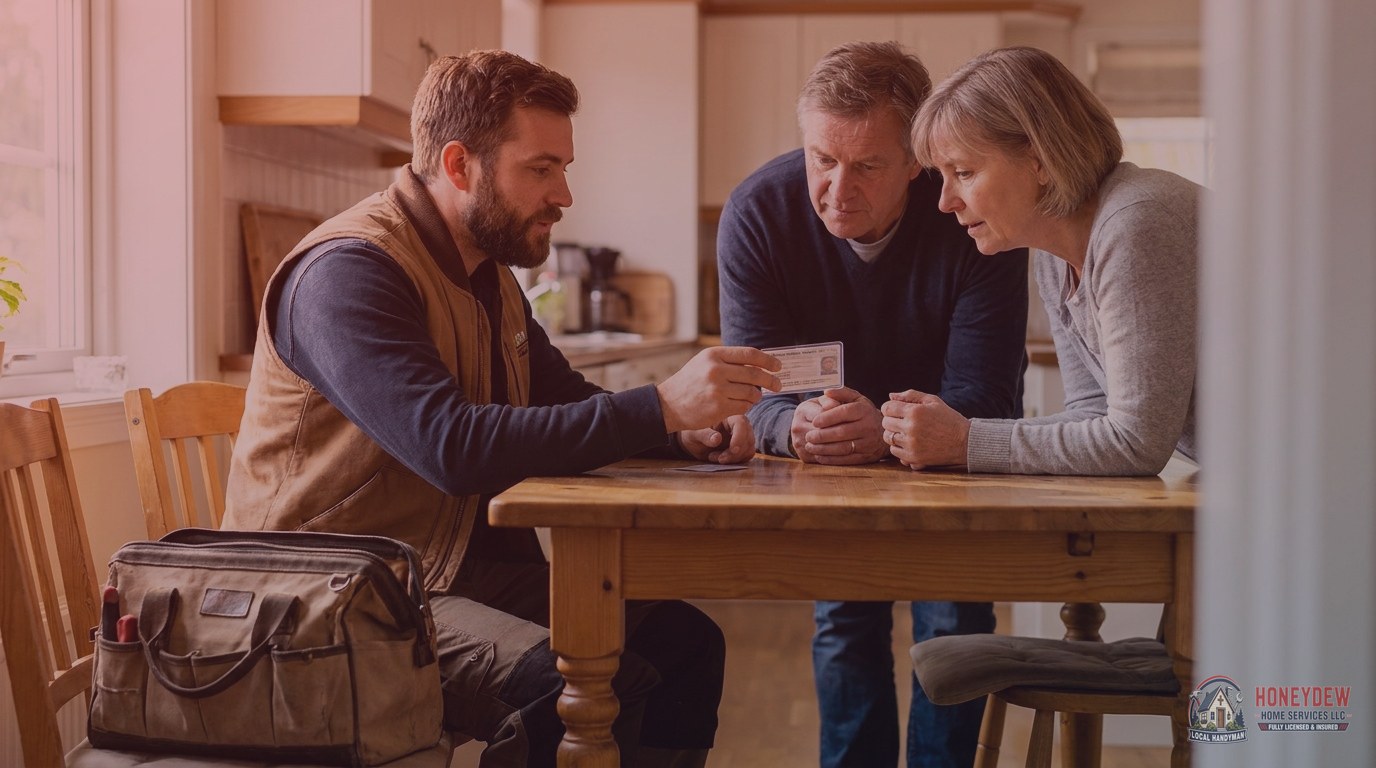
Here is the misconception worth correcting. Many Hampton homeowners assume any registered business is automatically a licensed handyman. That assumption is wrong. The Georgia Secretary of State’s Licensing Division regulates five distinct categories under Building and Contractors: Conditioned Air Contractors, Electrical Contractors, Low Voltage Contractors, Plumbers, and Residential and General Contractors. A legitimately licensed handyman holds the relevant trade endorsements for the work at hand plus general liability insurance. No single blanket credential exists.
Homeowners routinely confuse a registered LLC with a licensed trade professional. Forming an LLC is a business filing that creates a company on paper, and the filing says nothing about skill, testing, or insurance. A genuinely licensed trade professional has met state requirements for a specific trade. A business filing and a trade license look identical on a yard sign, so ask a handyman which license the handyman holds, not whether the business exists.
Georgia law also draws lines around project value and trade type. According to the City of Douglas (2024), the State of Georgia does not require a contractor license when a handyman project stays under $2,500, and specialty occupations such as roofers, painters, drywall contractors, and repair handymen are exempt from state licensing. The exemption ends at regulated trade territory: under O.C.G.A. § 43-41-17 (Georgia General Assembly, 2024), a specialty contractor cannot legally perform electrical, plumbing, or HVAC work without the matching Chapter 14 license. The Georgia Attorney General’s Consumer Protection Division (Consumer Ed, 2023) reports that a Residential-Basic Contractor license applicant must carry general liability insurance of at least $300,000 per occurrence.
Plenty of small jobs, like minor drywall patching, door adjustments, and caulking, fall below Georgia’s licensing thresholds, and anyone can legally perform that work. The risk for a homeowner rises sharply when an unlicensed worker takes on electrical panel work or plumbing rough-in without disclosing that the project crosses into regulated trade territory.
Licensure remains the baseline trust signal because the state has verified minimum competency and the license holder carries real accountability. A licensed handyman is a verified, accountable trade professional, distinct from an unlicensed handyman-for-hire who answers to no regulator. Georgia handyman licensure requires proof of insurance and compliance with state contractor regulations, protecting homeowners from liability, and the Georgia licensing protections for homeowners outline how that verification and insurance shield a household when a project goes wrong. Homeowners who ask to see a handyman’s trade endorsements and insurance certificate before work starts protect the project and the family budget.
What risks do Hampton homeowners face when they hire an unlicensed handyman?
Hampton homeowners who hire an unlicensed handyman face three risks: personal liability for on-site injuries under Georgia workers’ compensation law, no regulatory recourse for defective work, and unpermitted repairs that create title and insurance problems at resale.
An unlicensed handyman exposes the homeowner to personal liability for on-site injuries and property damage not covered by the worker’s insurance. Georgia law requires residential and general contractors to carry general liability insurance and, with three or more employees, workers’ compensation coverage, according to Consumer Ed, the Georgia Attorney General’s Consumer Protection Division (2023). Unlicensed workers commonly carry neither policy. Under O.C.G.A. § 34-9-8, a principal or subcontractor is liable for workers’ compensation benefits to any worker injured in the employ of a subcontractor, to the same extent as the immediate employer, when the injury occurs on premises the hiring party controls (Justia / Georgia General Assembly, 2020). A Hampton homeowner who hires an uninsured worker may therefore be treated as the de facto employer if that worker is hurt on the property, and the injury costs fall on the homeowner. The exposure disappears when the hired worker carries a workers’ compensation policy or operates under a licensed contractor’s coverage.
Georgia’s licensing boards accept complaints against licensed contractors, so a homeowner cannot report an unlicensed handyman when the work fails. Small claims court becomes the only remedy, and an uninsured worker rarely has assets to satisfy a judgment.
Unlicensed workers routinely skip Henry County permit requirements. Unpermitted repairs surface during the buyer’s inspection or title search at resale, and the seller pays for retroactive permits or corrective work before closing. The insurance problems extend beyond resale: homeowner’s insurance policies sometimes deny claims for damage caused by unlicensed workers, a clause most Hampton homeowners are unaware of until a claim is filed.
Why does hiring a local Hampton handyman matter beyond just being licensed?
Hiring a local Hampton handyman matters because local knowledge and accountability outlast what a license alone provides. Kenny Neville serves Hampton, GA residential homeowners with a licensed, insured handyman service rooted in Henry County, which delivers housing-stock familiarity, permit fluency, and fast follow-up that traveling competitors cannot match.
A local handyman brings familiarity with Hampton’s housing stock, neighborhood permit offices, and regional supplier relationships that traveling competitors do not carry. Older subdivisions near the Hampton city center hold specific material and code quirks: original galvanized supply lines, framing dimensions from another era, and past repairs done under building codes that have since changed. A handyman who works those streets every week recognizes these conditions on sight.
Permits separate locals from pass-through crews. According to the Henry County, GA Official Building Department, anyone who intends to construct, enlarge, alter, repair, move, or demolish a structure must first obtain a building permit, and skipping that step is an ordinance violation that can bring a stop-work order. A Hampton-based handyman pulls Henry County residential permits directly and knows which repairs require one, such as larger deck repairs and water heater replacements. App-dispatched workers typically skip this step, and the homeowner ends up holding unpermitted work that complicates a future home sale.
Community accountability also works differently at local scale. A Hampton handyman’s reputation lives within a few square miles, visible to neighbors and repeat customers on every job. Out-of-area platforms dispatch strangers whose standing resets at the county line; a local operator’s name stays attached to every repair he makes.
Follow-up tells the same story. Homeowners comparing the licensed handyman options in Hampton get warranty callbacks and return visits scheduled in days rather than weeks, because a local pro is already nearby.
How can Hampton homeowners verify a handyman’s license before hiring?
A Georgia homeowner can verify a licensed handyman’s credentials through the Georgia Secretary of State’s online license lookup before hiring. The search takes a name or license number, returns the license status, and costs nothing. Hampton, Georgia homeowners should pair that lookup with an insurance check before signing anything.

According to Consumer Ed, the Georgia Attorney General’s Consumer Protection Division (2023), homeowners open the Georgia Secretary of State’s website, choose “Licensing,” click “Licensee Search,” and select “Residential and General Contractors” under the “Building & Contractors” tab. A search on the handyman’s name or license number returns the license record. A valid result shows an active license in good standing, and the license number in the record matches the number the handyman provided.
Homeowners should also request written proof of general liability insurance and workers’ compensation coverage, because a license alone is not enough. A license does not pay for property damage or an injured worker on the property; those insurance policies do.
A handyman with no verifiable license number, who gives quotes only verbally, or who offers no written contract signals an unlicensed operator. Hampton homeowners should walk away from any contractor showing these red flags rather than hiring on trust.
Sources
- Justia / Georgia General Assembly, “Georgia Code § 43-41-17 (2024) – Effective date of licensing and sanctioning provisions” (2024)
- Georgia Secretary of State, “The Licensing Division – License Lookup”
- Justia / Georgia General Assembly, “Georgia Code § 34-9-8 – Liability of Principal Contractor or Subcontractor for Employee Injuries” (2020)