
Hiring the wrong handyman in Griffin, GA exposes a homeowner to unpermitted work, voided insurance claims, and costly redo jobs. A licensed residential handyman with verifiable credentials, local references, and transparent pricing protects Griffin homeowners from all three risks. Spalding County homeowners can confirm a handyman’s license, insurance coverage, and references before any work begins. Vetting a handyman costs nothing; hiring the wrong handyman costs thousands.
What does ‘licensed’ actually mean for a handyman in Griffin, GA?
Georgia issues no formal “handyman license,” so “licensed” for a Griffin handyman means verifiable local business registration, current insurance coverage, and work kept under the state’s $2,500 per-project threshold. Any project beyond that threshold requires a state contractor’s license.
The $2,500 threshold is the line Georgia draws between handyman work and contractor work. According to Adapt Digital Solutions (2026), no state license is required when general contracting work stays below $2,500 in project value. The City of Fayetteville, GA confirms that anyone performing general contracting above $2,500 in materials, labor, or any combination of the two must hold the proper class of license from the State Licensing Board for Residential and General Contractors. Materials and labor count together, so a $1,400 labor quote on a job with $1,300 in materials is a $2,700 project and belongs to a licensed contractor.
The threshold measures the total contracted value of the connected project, not the size of any single invoice. A handyman who splits one connected job into several smaller invoices to stay under $2,500 is practicing evasion, not compliance. Georgia closes that loophole at the permit counter: the City of Fayetteville notes that state law makes it illegal for any building department or permitting authority to issue a permit to an unlicensed contractor on projects exceeding $2,500. A homeowner who hires an unlicensed worker for an over-threshold job can end up with work that cannot legally be permitted or inspected.
Some work never qualifies for the handyman exemption at any price. Adapt Digital Solutions (2026) reports that specialty trade work such as electrical, plumbing, and HVAC requires its own separate trade license regardless of the dollar amount. Structural changes, such as removing a wall or altering load-bearing framing, fall under general contracting and permitting rules as well. A handyman can legally swap a light fixture’s like-for-like hardware in many cases, but new wiring runs, pipe modifications, and HVAC repairs belong to licensed trade contractors.
Homeowners should also separate two credentials that sound alike. A local business license, often issued as an occupation tax certificate by the city or Spalding County, registers the business to operate locally and pay local taxes; it does not test construction skill. A state contractor’s license from the State Licensing Board authorizes larger construction work. Routine repairs like drywall patching, painting, door adjustments, and gutter cleaning require only the local registration and insurance. A licensed handyman in Georgia is distinguished from an unlicensed handyman by verifiable state or local credentials and insurance coverage, and any scope of work exceeding the handyman threshold requires a licensed general contractor or specialty trade contractor under Georgia law.
Because Georgia offers no handyman license to look up, the word “licensed” on a business card or truck can mean anything or nothing. Verify, don’t assume. Ask which license the handyman holds, request the license number, confirm a state contractor license through the State Licensing Board’s public records, and call the insurance carrier to confirm active liability coverage. A pro with nothing to hide hands over those details before you ask.
How do you verify a handyman’s credentials before hiring in Griffin, GA?
A Griffin, GA homeowner should verify a handyman’s license status through the Georgia Secretary of State or Spalding County Building Department before hiring, then confirm current liability insurance and worker’s compensation coverage directly with the insurer before work begins.

1. Search the Georgia Secretary of State Corporations Division. Enter the handyman’s legal name or business name in the corporation search to confirm the business is registered and active in Georgia. 2. Check the Georgia State Licensing Board for Residential and General Contractors. The board’s public lookup shows whether the handyman holds a state contractor’s license and whether that license stands in good standing for larger projects. 3. Request documents directly from the handyman. Ask for proof of liability insurance, a worker’s compensation certificate or sole-proprietor exemption, and local business registration. 4. Call the insurer named on the certificate. A certificate proves coverage existed on its issue date; only the carrier can confirm the policy remains current.
Match the document request to the job size. Small repairs call for registration and insurance proof, while larger projects add the state contractor’s license check, and since Georgia issues no single wallet card for this trade, the combination of documents is the qualification signal rather than any one card.
Online reviews alone cannot complete this vetting. Reviews reveal punctuality, courtesy, and workmanship, but a five-star rating cannot confirm a license or a live insurance policy, which are the two checks that protect the homeowner financially.
When a handyman subcontracts specialty work such as electrical rough-in, confirm the subcontractor holds the required license, because the prime handyman’s license does not cover unlicensed subs.
The Griffin GA repair service options resource profiles local providers whose licensing and insurance records Griffin homeowners can compare.
What insurance should a handyman in Griffin, GA carry?
A handyman in Griffin, GA should carry general liability insurance covering property damage and third-party injury, plus workers’ compensation when the business employs three or more workers. Surety bonding protects against theft and unfinished work but stays optional on residential jobs.
General liability insurance pays for damage the handyman causes to your home and for injuries to anyone other than the handyman’s own employees. Construction Coverage reported in 2026 that state licensing boards may require only $50,000 to $100,000 in general liability coverage, while most commercial construction contracts require at least $2 million in aggregate coverage. A Griffin homeowner should treat the bottom of that range as a warning sign and ask for a certificate of insurance showing the current coverage amount.
Workers’ compensation covers the handyman’s own crew when someone gets hurt on your property. Work Injury Columbus reported in 2026 that, effective January 1, 2026, Georgia law requires employers with three or more employees to carry workers’ compensation insurance, lowered from the previous five-employee threshold. A legitimate sole proprietor who works entirely alone qualifies for an exemption, and that handyman should confirm solo status in writing before starting work.
A handyman without liability insurance exposes a Griffin homeowner to out-of-pocket costs for property damage or on-site injury. When an uninsured worker gets hurt inside your home, you can face medical bills, lost-wage claims, and a lawsuit that a standard homeowners policy may not fully absorb.
Bonding reimburses you if a handyman steals from your home or abandons a paid job. Bonds are not standard practice among residential handymen in the Griffin market, so treat an active bond as a bonus rather than a baseline requirement.
What are the biggest red flags when hiring a handyman in Griffin, GA?
The biggest red flags when hiring a handyman in Griffin, GA are a missing written estimate, demands for full payment before work begins, reluctance to pull required Spalding County permits, and an absence of verifiable references from recent Griffin-area jobs.
A vague or verbal-only scope of work is the single most predictive red flag in Griffin’s residential market. A legitimate handyman provides a written scope before requesting any payment, because the document also protects the handyman from scope-creep claims.
Three more warning signs deserve equal scrutiny:
- Full payment demanded upfront. Payment in full before any work begins shifts the financial risk onto the homeowner. A trustworthy handyman collects a deposit and bills the balance at completion.
- Pressure to skip permits. A handyman who dismisses permits for Spalding County jobs that require them shifts legal exposure onto the homeowner. Unpermitted repair work in Griffin, GA can result in failed home sale inspections, voided homeowner insurance claims, and mandatory tear-out costs.
- Contract-splitting offers. A handyman who proposes breaking one large job into multiple sub-$2,500 contracts raises a separate concern. According to HowToStartABusinessGeorgia.com (2026), Georgia regulators and courts treat contract-splitting as evasion, which ranks among the risks of unlicensed handyman work.
- No local references. A handyman working regularly in Griffin can point to completed jobs nearby. A homeowner who cannot verify a single recent Griffin-area project should keep looking.
One final check matters in Griffin’s older neighborhoods. Pre-1980 homes can hide asbestos or lead paint behind walls and under flooring, and a properly credentialed handyman knows when to stop work and refer the job to a certified abatement specialist rather than proceed.
Why does Kenny Neville / Honeydew meet the standard for a trusted licensed handyman in Griffin, GA?
Kenny Neville serves Griffin and Spalding County as a licensed residential handyman with verifiable credentials. Honeydew carries insurance, specializes in residential home repair and maintenance, operates from a physical presence in Middle Georgia, and provides estimates directly to local homeowners.
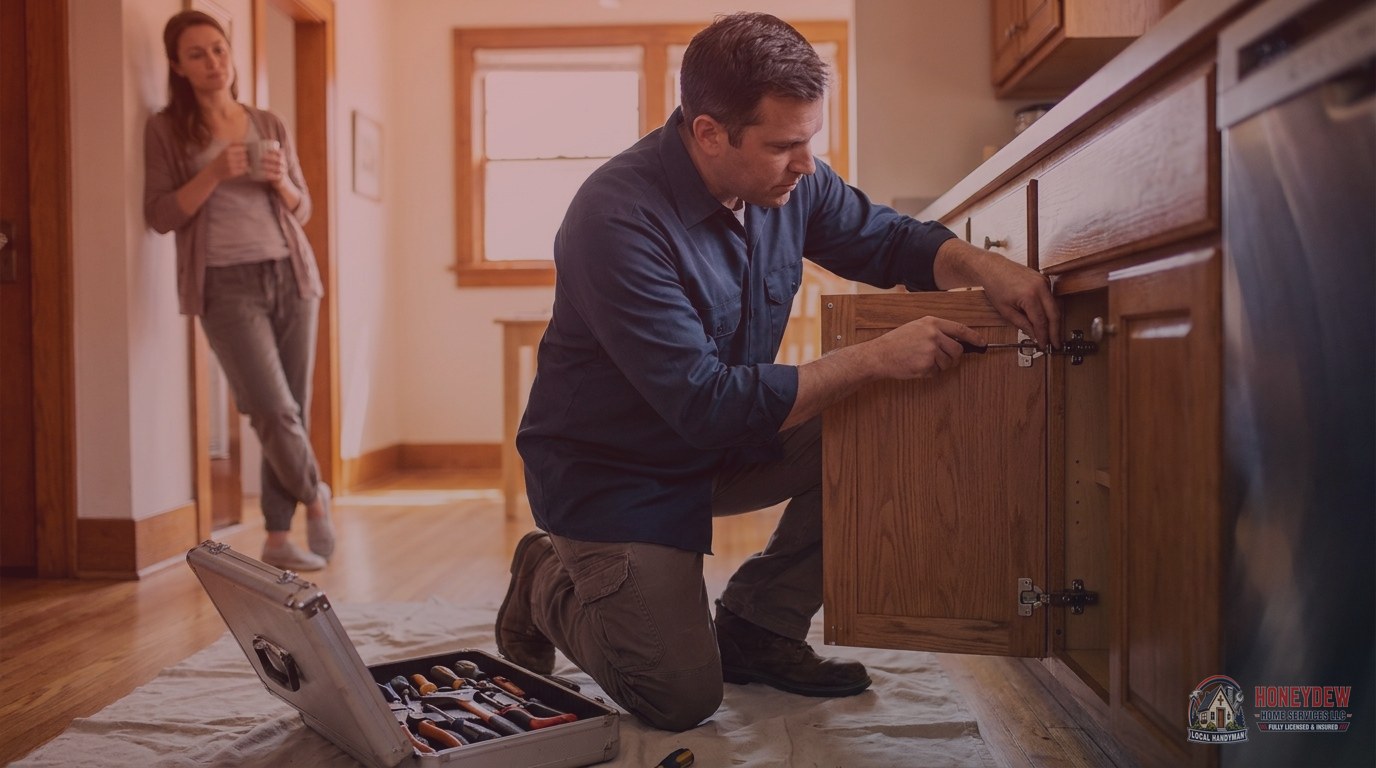
Honeydew holds the licensed and insured status Griffin homeowners should require from any handyman, and the business shares current license and insurance documentation on request. Ask for proof. A handyman who verifies credentials without hesitation clears the biggest trust hurdle before work begins.
Honeydew works exclusively on residential properties, covering the repair and maintenance tasks Griffin homes actually need: drywall patching, door and trim adjustments, fixture replacement, and minor carpentry.
Honeydew is based in the Middle Georgia service area, not behind a remote dispatch desk that brokers jobs to subcontractors. When a homeowner calls, Kenny Neville answers for the estimate, the work, and any follow-up.
Griffin homeowners can request an estimate from Honeydew by phone or through the website contact form.
Sources
- Adapt Digital Solutions, “Georgia Contractor License Requirements (2026): $2,500 Rule” (2026)
- City of Fayetteville, GA, “Contractor Licensing Requirements”
- HowToStartABusinessGeorgia.com, “How to Start a Handyman Business in Georgia” (2026)
- Work Injury Columbus, “GA Workers’ Comp: 3+ Employees Now Must Insure” (2026)
- Construction Coverage, “Contractor General Liability Insurance Requirements” (2026)