
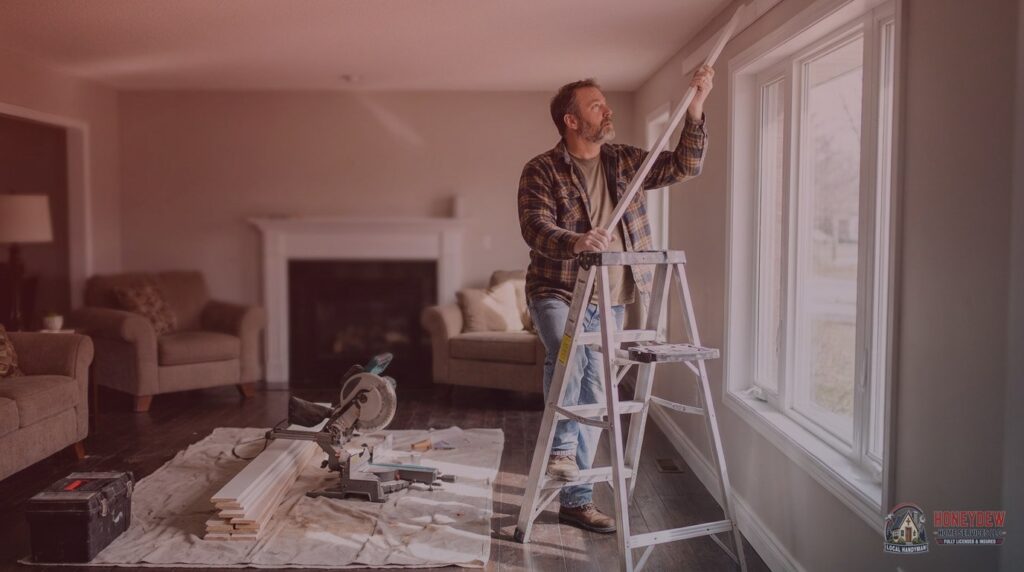
Trim and molding upgrades installed by a licensed handyman rank among the highest-ROI interior improvements a Georgia homeowner can make before listing a property or modernizing a dated room. Crown molding, chair rail, picture rail, upgraded window and door casing, and coffered ceiling trim each sharpen a home’s finish and signal quality to buyers. A licensed local handyman installs these five upgrades faster, cleaner, and with tighter joints than a weekend DIY attempt typically allows.
How does crown molding add value to a Georgia home?
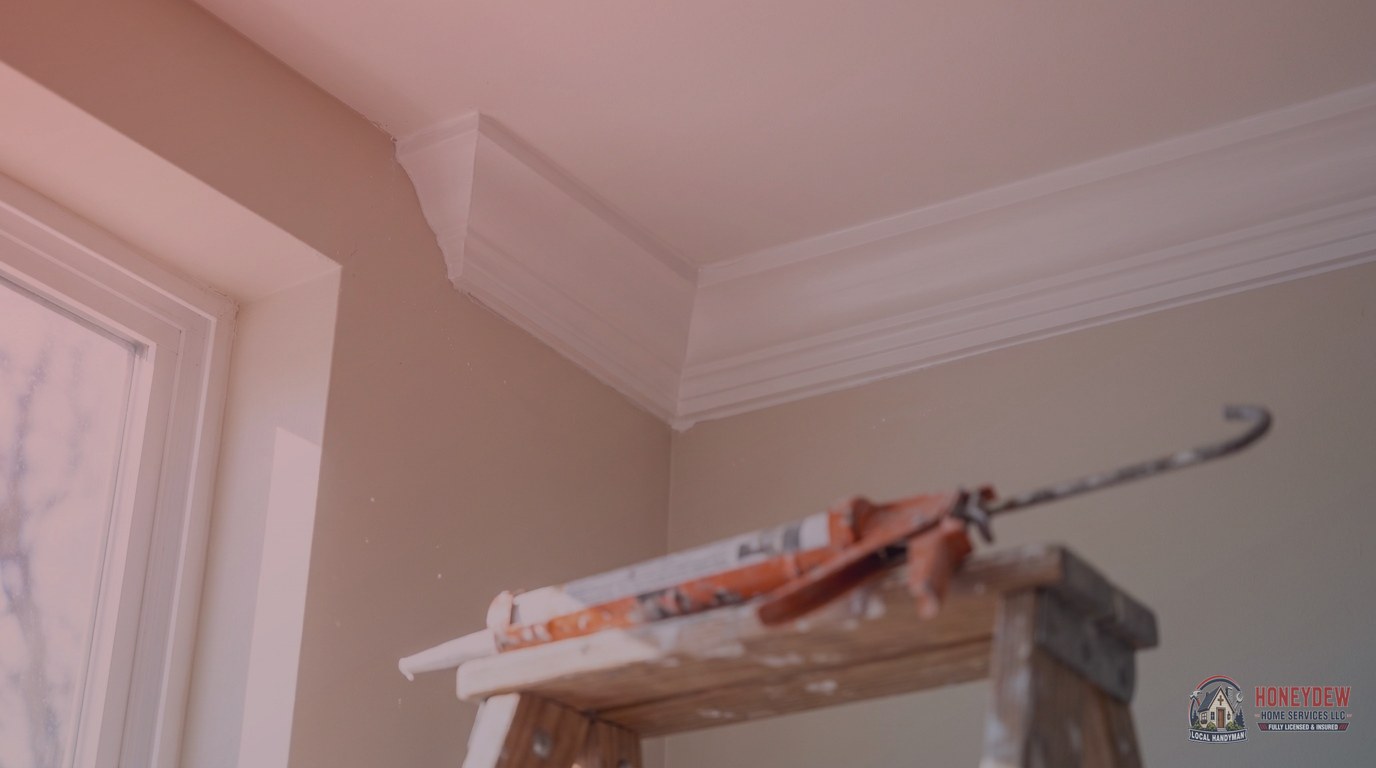
Crown molding installation adds value to a Georgia residential home’s resale price and buyer perception by signaling custom interior finish quality. Buyers and appraisers read crown molding as evidence of a finished interior rather than a builder-grade one.
In a Metrie survey reported by New England Building Supply in 2018, 97% of real estate professionals said moldings and trim affected the overall price of a home, and more than 90% of the real estate and construction professionals surveyed said they were likely to recommend a trim upgrade before listing a home. Metrie ranked crown molding at the top for return on investment among common remodel updates. Orchard reported in 2023 that crown molding alone does not increase a home’s value, but combined with quality finishes like wainscoting, crown molding contributes to an overall higher home value. Georgia buyers place crown molding paired with wainscoting among the trim upgrades that boost home value.
A licensed handyman protects that value through four decisions:
1. A licensed handyman matches the profile to the ceiling height. Crown molding delivers peak perceived value in rooms with ceilings of 9 feet or higher. In a standard 8-foot Georgia ranch or split-level home, crown molding can read as cramped rather than elegant. A handyman must select a proportionate width, typically a narrower profile that flatters the lower ceiling. 2. A licensed handyman chooses paint-grade MDF over solid wood. Georgia’s humid climate warps solid wood profiles over time. Paint-grade MDF resists warping, holds a painted finish well, and serves as the dominant crown molding material in Georgia homes for that reason. 3. A licensed handyman eliminates visible gaps at corners. Visible corner gaps are the most common DIY crown molding failure, and those gaps devalue the upgrade on sight. Buyers spot corner gaps immediately. Professional installation produces tight, clean corner joints. 4. A licensed handyman uses rosette corner blocks on out-of-square walls. Older Georgia homes often have out-of-square walls that make mitered corners expensive to fit. Rosette corner blocks save money on out-of-square corners, and a skilled handyman places the blocks strategically to achieve a clean finish without expensive rework.
Does chair rail molding still add value, and how should it be installed in a Georgia home?
Yes. Chair rail molding still adds value in a Georgia home when the rail is paired with wainscoting below and installed at one-third of wall height, typically 32 to 36 inches from the floor in residential rooms.
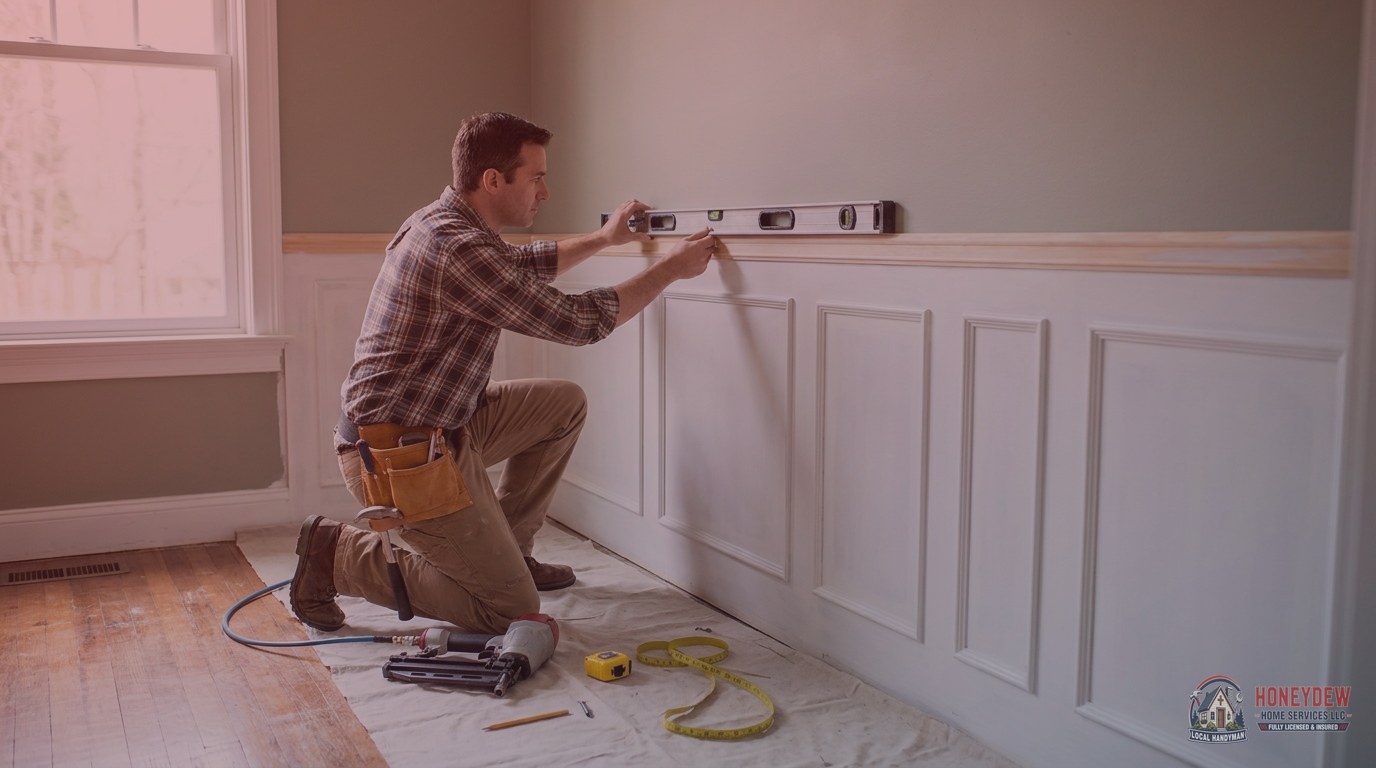
Chair rail paired with wainscoting signals craftsmanship quality that distinguishes a home from builder-basic finishes. Chair rail alone, with bare drywall beneath, often looks unfinished in modern Georgia homes. Chair rail installed without wainscoting can actually reduce the polished feel buyers expect. The complete composition carries the value. According to Absolute Properties HTX (2025), buyers who walk into a home with high-quality wainscoting immediately perceive the property as higher-end or more custom than a neighboring home with plain walls.
Industry standards place chair rail at one-third of the total wall height from the floor, typically 32 to 36 inches in Georgia residential rooms. For a standard 9-foot ceiling, Absolute Properties HTX (2025) recommends about 36 inches, including the chair rail.
In Henry County and across metro Atlanta, dining rooms, hallways, and primary staircases suit chair rail best in craftsman and colonial-revival Georgia homes. iBuyer.com (2025) reports that buyers have cited entry-to-dining wainscoting continuity as a quality differentiator.
Beadboard is the most common wainscoting material paired with chair rail in Georgia homes, and beadboard comes in tongue-and-groove panels or sheet form. Sheet beadboard installs faster, but the sheet form shows seams over time in humid climates.
What is picture rail molding and is it a good upgrade for Georgia homes?
Picture rail molding is a horizontal trim strip installed high on a wall, just below the ceiling, that holds hooked hardware for hanging frames and mirrors. It is a good upgrade for Georgia homes because it combines period-correct decoration with practical, nail-free hanging.
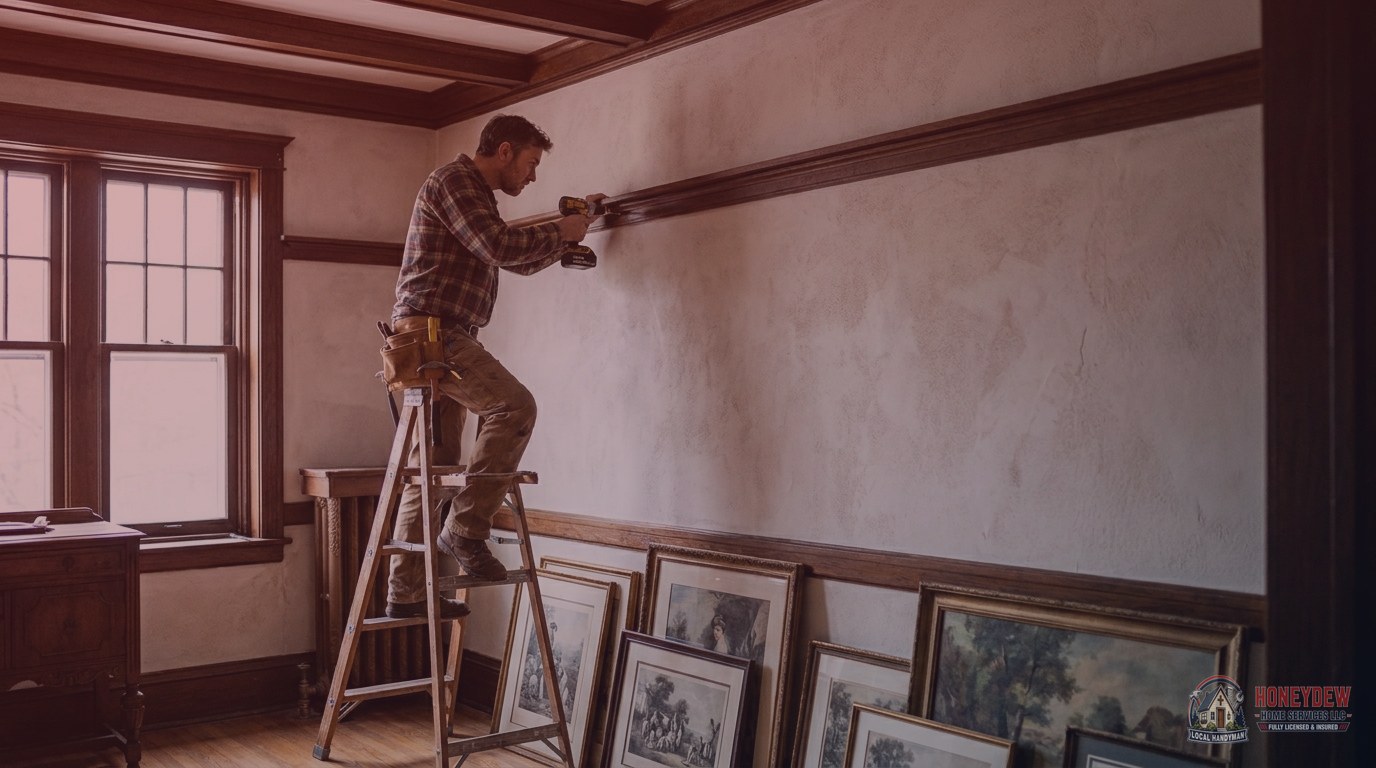
- Dual function: Picture rail works as ornament and hardware at once. Hooks and wire suspend artwork from the rail, so walls stay free of nail holes even when a homeowner rotates displays seasonally.
- Historic fit: Picture rail molding is suited to older Georgia craftsman and bungalow homes where the wall assembly already anticipates it. The rail was original equipment in many pre-1960s craftsman bungalows and colonial-revival houses, so installing it restores intended detail rather than adding a foreign feature.
- Staging ROI: Material cost stays low relative to visual impact, which makes picture rail a high-ROI upgrade in homes being staged for sale. A single continuous rail sharpens a room’s sightlines in roughly one day of work.
Material choice matters in Georgia’s humidity. MDF performs well for molding provided ambient humidity remains below 65% relative humidity, according to Sumec Building Material (2024), and moisture-resistant MDF handles damp rooms better than untreated stock, which swells and loses structural integrity when exposed to water (The Panel Hub, 2023).
One honest limit: picture rail is not load-bearing at scale. Framed art or mirrors over 20 lbs should hang from a dedicated hanging system or wall anchor, not from picture rail hooks alone.
How does upgrading door and window casing add value to a Georgia home?
Upgraded door and window casing replaces flat colonial or ranch-style builder-basic trim that dates a home, and the wider profiled casing signals finished craftsmanship to buyers and appraisers, lifting perceived quality, curb appeal, and resale value across Georgia housing markets.

Builder-basic flat colonial casing is the default trim in most 1990s through 2010s Georgia subdivisions, and buyers immediately read that plain profile as unfinished. Every doorway trimmed with builder-basic casing quietly lowers the perceived quality of the whole home.
Craftsman-style casing with a head plinth and side legs is the most in-demand upgrade across Georgia’s Henry County and metro Atlanta markets. The squared, substantial profile flatters both ranch and two-story subdivision homes.
An entry door casing upgrade delivers the highest visual return of any casing upgrade. The wider front-door surround strengthens curb appeal because the doorway anchors the exterior approach, and the entry casing is the first interior detail buyers see, so one upgrade pays twice during a single showing.
Sellers planning a resale budget can compare casing work against other Georgia home repairs with best ROI to sequence trim upgrades alongside bigger-ticket repairs.
Can a handyman install coffered ceiling trim, and does it add real value in Georgia homes?
Yes. A handyman installs coffered ceiling trim as a lightweight MDF grid kit mounted over existing drywall, so the project needs no structural work or permits. The upgrade adds real resale value in Georgia homes with ceilings at least nine feet high.
A kit-built coffered ceiling is not the same as a structural coffered ceiling. Structural coffers require framing changes and permits, while MDF grid systems fasten to a finished ceiling, so a handyman installs these lightweight kits without structural permits. Homeowners seeking dramatic architectural impact without structural renovation use coffered ceiling trim installation for exactly that reason.
A typical kit installation follows five steps:
1. Confirm the ceiling height measures at least 9 feet, because lower ceilings feel closed in under a dropped grid. 2. Map the grid layout across the existing drywall. 3. Fasten the MDF beams to the ceiling joists. 4. Fit molding profiles inside each recessed panel. 5. Caulk, prime, and paint the finished grid.
The finished grid delivers dramatic visual impact in living rooms and primary bedrooms of Georgia craftsman, ranch, and new-construction homes. That nine-foot check matters most in ranch styles, since many ranch floor plans carry lower ceilings. According to a 2024 AOL Lifestyle report, coffered ceilings rank among the top ceiling trends for 2025 and add strong soundproofing, a taller-looking ceiling, and a significant resale boost. A 2024 Family Handyman article cites a licensed Realtor who describes coffered ceilings as a luxury detail typical of higher-end homes, with a good chance of recouping installation cost at resale in expensive neighborhoods.
Kenny Neville handyman service provides licensed residential trim installation across Georgia, including Henry County and metro Atlanta, and a pre-installation visit confirms ceiling height and joist layout before any kit is ordered.
Sources
- New England Building Supply, “Why Updating Your Trim Design Increases Overall Home Value” (2018)
- Metrie, “Crown Molding Sizes & Dimensions: Everything You Should Know”
- Absolute Properties HTX, “What Is Wainscoting – And Does It Add Value to a Home?” (2025)
- iBuyer.com, “Does Wainscoting Add Value to Your Home?” (2025)
- Orchard, “Does Crown Molding Add Any Value to Your Home?” (2023)
- The Panel Hub, “Putting MDF Durability to The Test: Is It Really All That?” (2023)
- Sumec Building Material, “Plywood vs. MDF: Which Board Is Best for Your Project?” (2024)
- AOL Lifestyle, “The Timeless Design Trend That Is Slowly Replacing Picture Frame Molding” (2024)
- Family Handyman, “Are Coffered Ceilings Worth It?” (2024)