
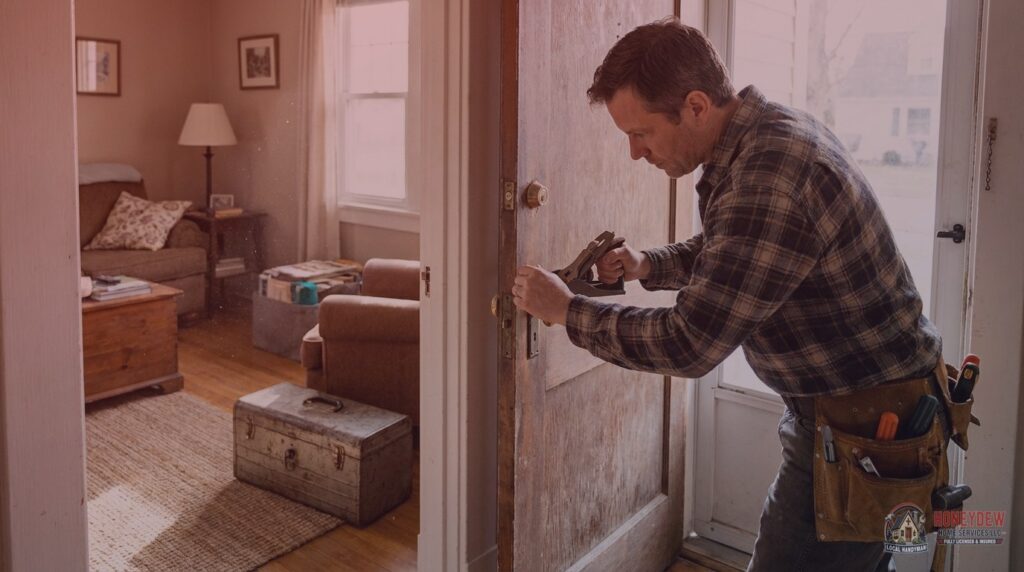
Kenny Neville repairs and installs residential doors as a licensed local handyman serving Hampton, Locust Grove, Griffin, and the surrounding Middle Georgia area. Kenny Neville works on interior and exterior doors, fixing sticking doors, broken hinges, latch failures, and worn weatherstripping. Kenny Neville finishes the job in a single visit, from planing a sticking bedroom door to setting a new pre-hung exterior door.
What door repair and installation services does Kenny Neville offer?
Kenny Neville is a licensed residential handyman serving Hampton, Locust Grove, and Griffin, GA, and his door repair and installation work covers sticking doors, broken or loose hinges, latch and strike plate repair, weatherstripping replacement, pre-hung door installation, and screen door repair throughout the surrounding Middle Georgia communities.
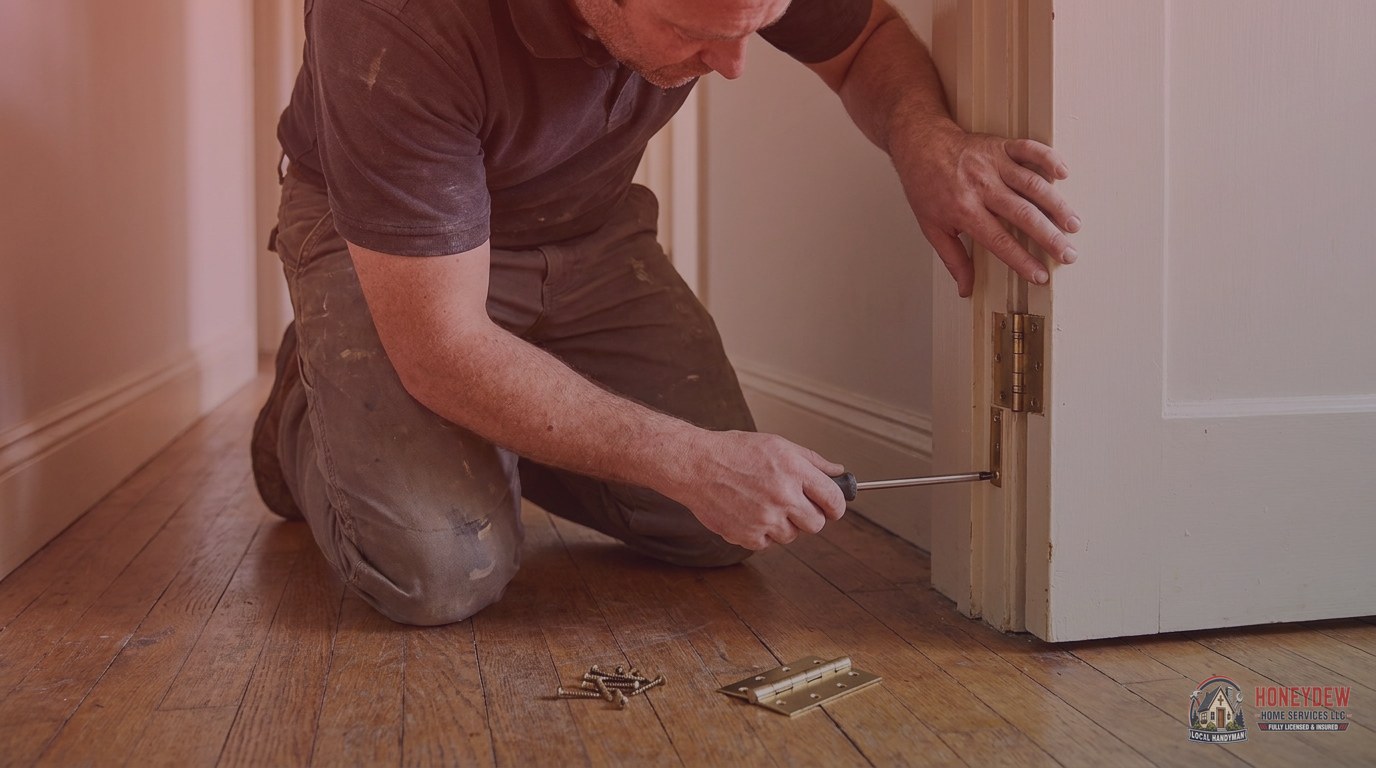
1. Sticking doors: Kenny Neville planes binding edges, corrects swollen or shifted frames, and adjusts hinge positions so the door swings and closes cleanly. 2. Broken or loose hinges: Kenny Neville replaces stripped hinge screws, resets sagging hinges, and swaps out damaged hinge hardware. 3. Latch and strike plate repair: Kenny Neville realigns strike plates and adjusts or replaces worn latches so the door catches and stays shut. 4. Weatherstripping replacement: Kenny Neville removes cracked or compressed weatherstripping and installs new seals that block drafts around exterior doors. 5. Pre-hung door installation: Kenny Neville explains what pre-hung door installation involves during scoping, then sets the unit plumb and level, shims the frame, and fits the casing for a finished opening. Screen door repair: Kenny Neville rescreens torn mesh, replaces worn rollers, and fixes screen door closers. The Griffin screen door fix options detail this work for Griffin homeowners.
The service covers interior doors, including bedroom, closet, and bathroom doors, and exterior doors, including entry, storm, and screen doors. The door and carpentry repair options document related jamb, trim, and frame repairs that frequently accompany door work.
Kenny Neville works as a licensed residential handyman, not a general contractor, so the service fits common door repairs and standard installations rather than structural reconstruction. This door repair and installation scope suits homeowners seeking a single licensed pro rather than a specialty contractor for common door problems.
Kenny Neville completes most door repairs in a single visit, without a return trip, which keeps a sticking hinge or failed latch from turning into a two-appointment project.
Why is my door sticking, and can a handyman fix it?
A door sticks for three reasons: humidity swells the wood, worn hinges let the slab sag, or a settling foundation shifts the frame. A licensed handyman corrects hinge and fit problems and flags foundation movement for a structural specialist.
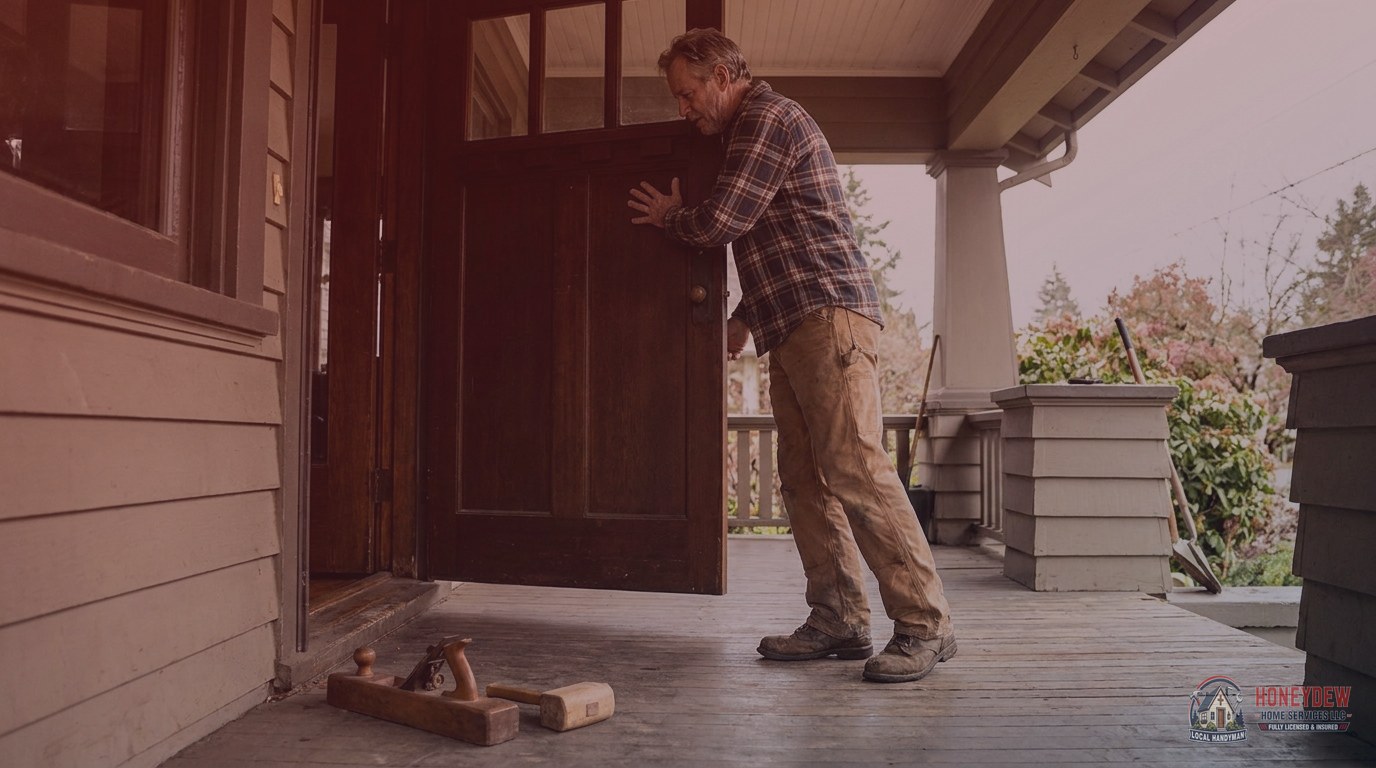
Three problems cause sticking doors in Middle Georgia: humidity-driven wood swelling, hinge failure, and foundation shift. MD Canada reports that wooden doors can swell by up to 5% in humid environments, and that swelling explains most doors that bind in Hampton GA. Moisture exposure also drives how interior and exterior doors differ in repairs, since exterior slabs take weather directly.
The timing reveals the cause. In Middle Georgia’s humid climate, most sticking doors are a wood-swelling problem that resolves when the season turns; a door that sticks year-round points to hinge failure or frame movement. The distinction dictates the fix: planing a seasonally stuck door removes wood the door needs in drier months, leaving a gap once the lumber shrinks.
For hinge and fit problems, a handyman tightens or replaces hinges, planes minor rub spots on year-round sticking doors, and adjusts the strike plate so the latch seats cleanly. Loose or squeaking hinges deserve early attention: tightening the hinge screws, or replacing the screws with longer structural screws that bite into the framing, is a five-minute fix that eliminates squeaking and corrects minor sagging before the sag becomes a sticking problem.
Some sticking exceeds handyman scope. Sticking paired with diagonal drywall cracks above the frame, separating trim, or a latch that has visibly drifted signals foundation movement. A handyman identifies those signs during the visit, and the homeowner’s next call goes to a foundation repair contractor, not to more planing.
What causes a door to not latch properly, and how is it fixed?
A door fails to latch when the latch bolt misses the strike plate opening in the frame. Door latch failure is caused by strike plate misalignment, a worn latch mechanism, or door frame settling. The fix is repositioning the strike plate, elongating the mortise, or replacing the worn latch.
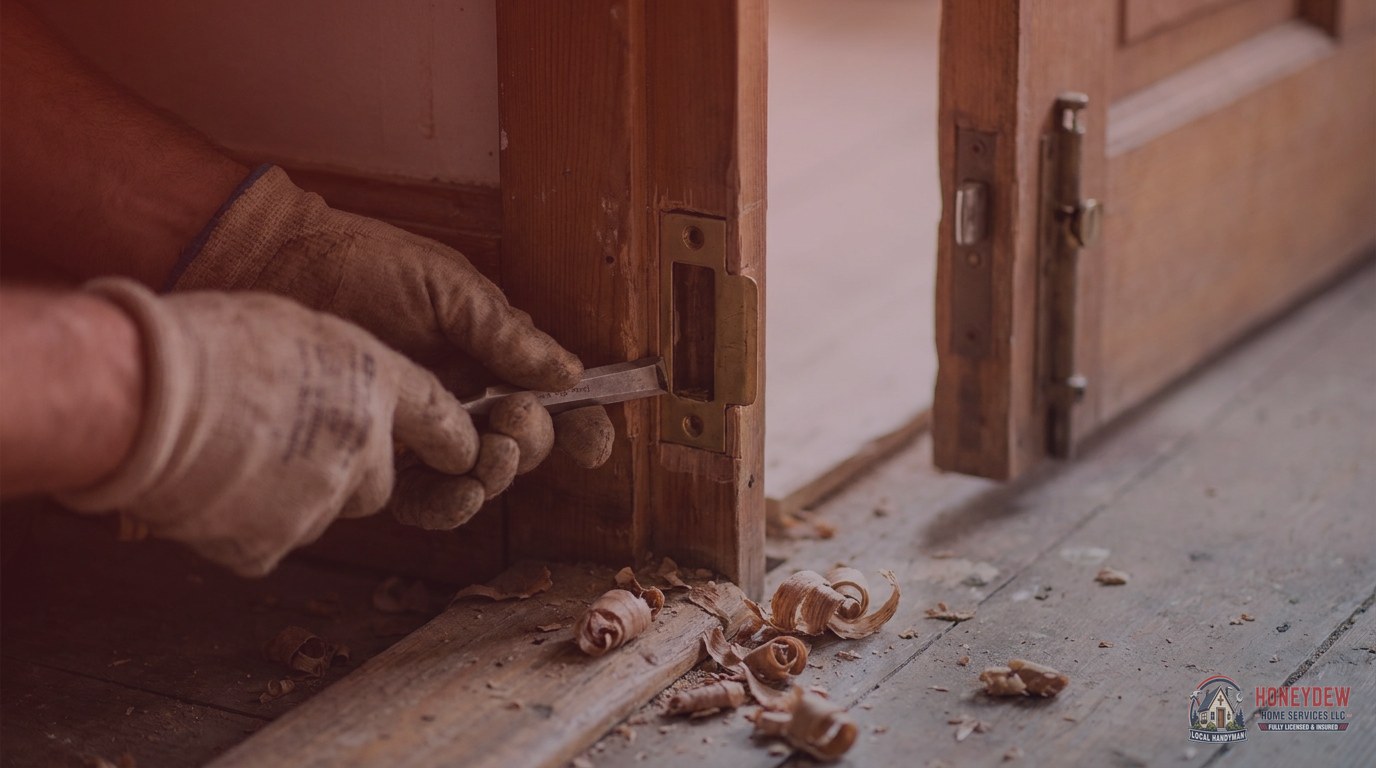
Strike plate misalignment is the primary cause in most homes. As a house settles, the door frame shifts, and the plate drifts out of line with the latch bolt. Humidity swings across Middle Georgia speed that movement in wood-framed construction.
Here is the part homeowners get wrong: a door that will not latch is almost never a lockset problem. The failure is almost always a strike plate alignment issue, correctable by repositioning the plate or elongating the strike plate mortise. That makes it a 15-minute fix that homeowners often misdiagnose as a lock replacement job, so fixing a door that won’t latch usually costs far less than a new lockset.
A worn latch mechanism is the exception. When the internal spring weakens, the bolt no longer extends firmly, and replacing the latch is the right repair. The choice of when repairing beats buying new depends on the condition of the surrounding hardware, since a solid door and frame rarely justify a full lockset upgrade.
The stakes differ by door type. An interior latch failure costs privacy. An exterior latch failure is a security issue, because a latch that never catches leaves the deadbolt as the only thing holding the door, and a proper repair includes checking the plate screws and frame for signs of forced-entry stress.
When should weatherstripping on a door be replaced?
Replace door weatherstripping when daylight shows around the closed door, drafts reach the door’s edges, energy bills rise without another cause, or water crosses the threshold. Georgia’s humidity breaks down foam and rubber seals faster than drier climates do, so Middle Georgia doors need replacement sooner.
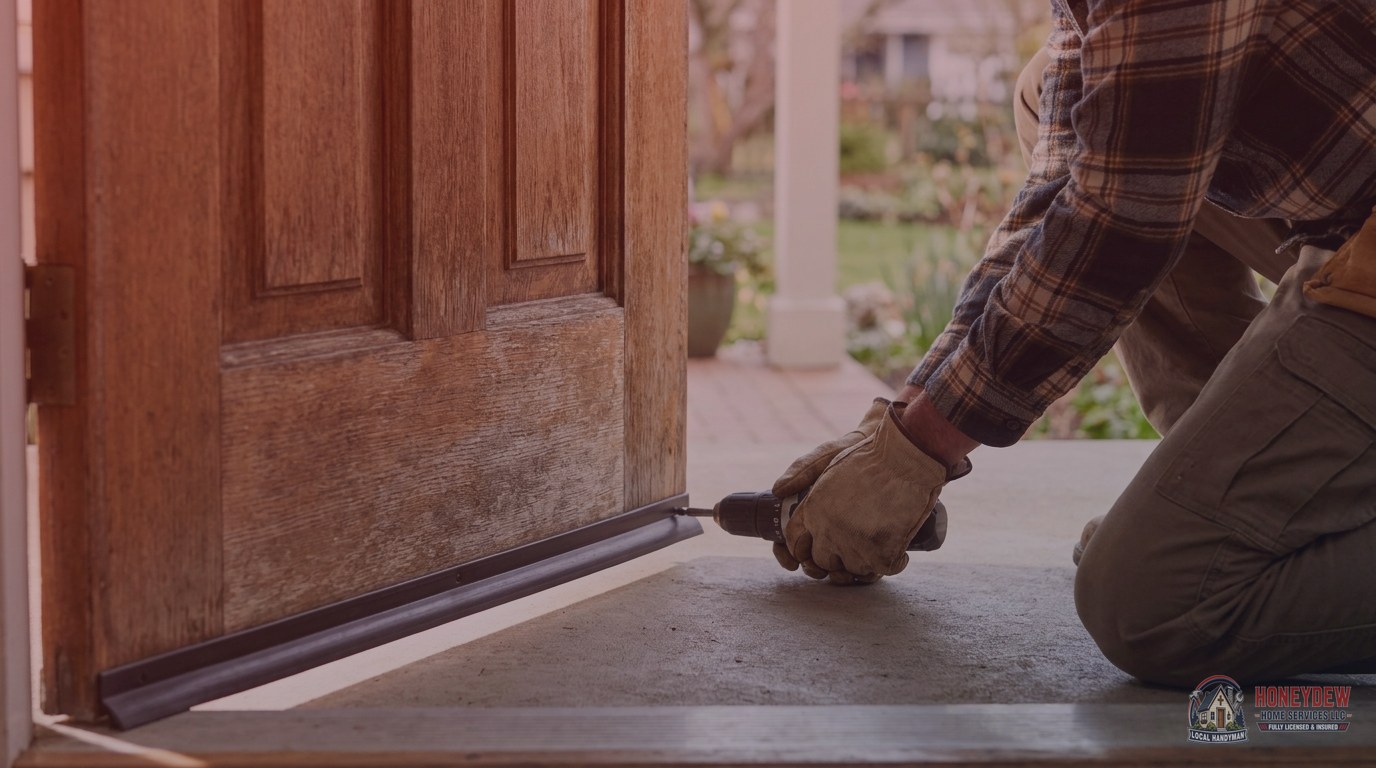
Weatherstripping seals the gaps between a door and its frame, blocking outside air, moisture, and pests while holding conditioned air inside. Doors account for 11 percent of a typical home’s overall heat loss, according to the Illinois Department of Commerce and Economic Opportunity, so a worn seal costs money in every season.
Humidity also swells wood doors and weakens adhesive backing, which is why weatherstripping replacement applies to exterior doors losing conditioned air in Georgia’s humid climate, not just to doors with visibly torn seals. Swollen frames and sticking slabs rank high among Georgia’s chronic door and window issues, and failed weatherstripping usually rides along with them.
Kenny Neville replaces four weatherstripping types: door sweep, foam tape, V-strip, and door-bottom seal. He removes the failed material, cleans the contact surface, cuts the new seal to size, and tests the latch and close before calling the job done. The failing weatherstripping repair options that fit a given door depend on gap width and door material, and Kenny matches the seal to both.
What does a pre-hung door installation involve?
A pre-hung door installation contains the door slab, frame, and hinges as a single unit requiring shimming, plumbing, and finish trim. The installer sets the whole assembly into the rough opening at once, rather than fitting a bare slab into an existing frame.
Pre-hung door installation follows a set sequence:
1. Remove the old door, hinges, and frame down to the rough opening. 2. Set the pre-hung unit into the opening and shim the unit plumb, level, and square. 3. Secure the frame to the wall framing through the shims. 4. Add casing trim and fit the threshold.
An exterior pre-hung door adds weatherstripping, a door sweep, and a sealed threshold, so an exterior installation carries more scope than an interior installation. Kenny Neville scopes the full job before booking and handles pre-hung installation in standard rough openings. Structural changes to the opening itself, such as widening a load-bearing wall, belong to a licensed contractor.
Screen door repairs rank as a high-frequency seasonal request in Griffin and Hampton, where two distinct service items, torn screen replacement and broken closer hardware, peak through the warmer months. Kenny Neville performs screen door repair and replacement in Griffin, GA as a standalone service, or homeowners can add screen door work to the same door repair visit.