
The wrong handyman costs McDonough homeowners wasted money, unfinished work, and jobs that stall because an unlicensed contractor cannot pull a Henry County permit. A local, licensed handyman with verifiable Henry County experience eliminates every one of those risks before the first nail is driven. Kenny Neville built Honeydew Home Services, his McDonough handyman company, on exactly that standard for Henry County homeowners.
What makes McDonough homes different, and why does local handyman experience matter?
McDonough’s rapid growth since 2010 means a large share of the housing stock consists of builder-grade homes built in the 2000s and 2010s. Those homes share predictable failure points, and a handyman with Henry County job history recognizes the patterns on sight, cutting diagnostic time and call-backs.
Henry County ranked among the top counties in Georgia for total housing permits approved from 1980 through 2020, with 74,839 permits issued over that period, according to the Georgia Public Policy Foundation (2025). U.S. Census Bureau building permit data tracked by FRED (2025) shows Henry County approved more than 3,700 residential permits per year in every year from 2000 through 2005, peaking at 4,689 permits in 2002 before collapsing to 247 permits in 2009. That boom built McDonough’s neighborhoods.
According to Point2Homes, McDonough’s housing stock consists of 10,711 units, 59.6% of them detached single-family homes, with a median construction year of 2006. Homebuilders completed 48.1% of these homes between 2000 and 2009 and another 26.7% between 2010 and 2019, so roughly three of every four McDonough homes date to the 2000s or 2010s. Much of that stock is builder-grade, meaning standard contractor-grade materials and components chosen for cost and speed.
Builder-grade construction reaches its first major maintenance cycle at a predictable age, and McDonough’s stock is arriving there together. The recurring failures cluster in four places: caulk joints around fiber-cement siding shrink and crack under Georgia heat and humidity; original coated deck fasteners corrode and loosen; builder-installed HVAC transitions wear at the duct connections after years of vibration; and aging water heater installations reach the end of their service life. Each one announces itself the same way in house after house.
A handyman with a long Henry County job history has repaired these failures on many similar homes and recognizes each pattern on sight. That familiarity shortens the diagnostic visit and produces a fix that holds the first time, which means fewer call-backs for the homeowner. A generalist from outside the area treats the same job as a novel problem, diagnosing from scratch and pricing in the uncertainty. Local build standards repeat, so local experience compounds.
Figures published by Henry County, Georgia in 2025 count an estimated 94,068 housing units countywide as of July 1, 2023, with 72.5% owner-occupied against a 65.4% statewide rate. The person hiring the handyman here is usually the person who lives with the result. Homeowners can match each of these failure categories to the trusted handyman trades in McDonough, which cover exterior sealing, deck repair, and similar recurring work.
How do you vet a handyman in McDonough, GA before hiring?
A reliable handyman in McDonough, GA is verified by proof of liability insurance, a verifiable business license, and local references from Henry County jobs. Homeowners confirm each of these through four checks before signing any agreement or paying a deposit.
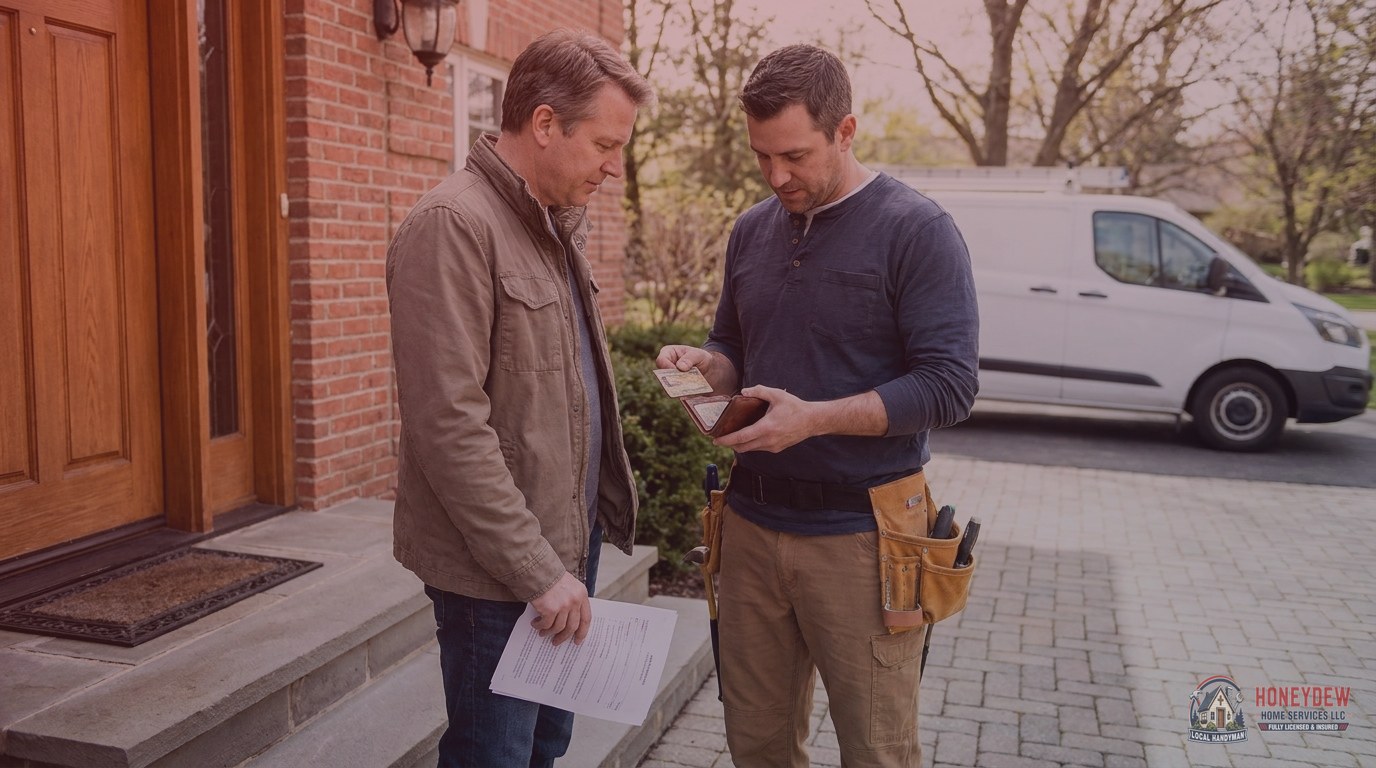
1. Confirm liability insurance with a certificate. Ask the handyman’s insurer to send a certificate of insurance naming you, the homeowner, as certificate holder. A verbal claim proves nothing. The certificate documents active liability protection for work on your property.
2. Verify the business registration or trade license. According to the Georgia Secretary of State, the State Licensing Board for Residential and Commercial General Contractors is the official licensing body where homeowners can verify a contractor’s credentials. The Henry County licensing office confirms local business registration.
3. Read reviews tied to McDonough jobs. Check Google, Nextdoor, and McDonough/Henry County Facebook groups for feedback on local jobs, not generic metro Atlanta reviews. Nextdoor and local Facebook groups are often more reliable than national platforms like Angi or HomeAdvisor, because the review pool reflects actual neighbors with firsthand Henry County experience.
4. Request references from recent, similar jobs. Ask for two or three customers from the past year whose projects match yours, then call them directly. Skip the testimonials posted on the handyman’s own website.
Online reviews and word-of-mouth referrals are unreliable without cross-checking the contractor’s license status and insurance certificate directly. The key handyman interview questions cover what to ask about availability, pricing, and past Henry County projects once a candidate passes these checks.
Does a handyman in Georgia need to be licensed?
Georgia does not issue a statewide handyman license. Licensing obligations depend on the trade type and the total job value: projects at or above $2,500 require a state contractor’s license, and electrical, plumbing, and HVAC work always requires a separate Georgia trade license.
According to USA Trade License (2026), Georgia has no official state-issued handyman license, and workers are exempt from contractor licensing only when the total project cost, including labor and materials, stays under $2,500. That structure trips up many homeowners. Asking “are you licensed?” invites a vague yes or no; the better question is which specific Georgia licenses the handyman holds and for which scopes of work.
Georgia law requires contractors performing work above a certain dollar threshold to hold a state-issued license, making unlicensed handymen a legal and financial risk for homeowners. Next Insurance (2025) reports that Georgia requires a Residential-Basic Contractor license for any residential construction, remodeling, or repair project where the total contract value equals or exceeds $2,500. Under O.C.G.A. § 43-41-17, a contract for work requiring that license is unenforceable by a contractor who does not hold a valid, current license (Justia / Georgia General Assembly, 2024).
The trade licenses operate independently of job cost. USA Trade License (2026) confirms that even on jobs under $2,500, Georgia prohibits handymen from performing electrical, plumbing, conditioned air (HVAC), or low-voltage work without the corresponding state trade license.
The risk reaches beyond fines. A homeowner can face legal exposure when an unlicensed worker is injured on the property during unpermitted work, because liability that a licensed, insured contractor would normally carry can shift to the property owner.
What should a reliable handyman provide before and after the job?
A reliable handyman provides four things: a written estimate, a clear timeline, a lien waiver at completion, and written warranty terms. These documents protect McDonough homeowners from disputes, surprise costs, and legal claims long after the tools are packed up.
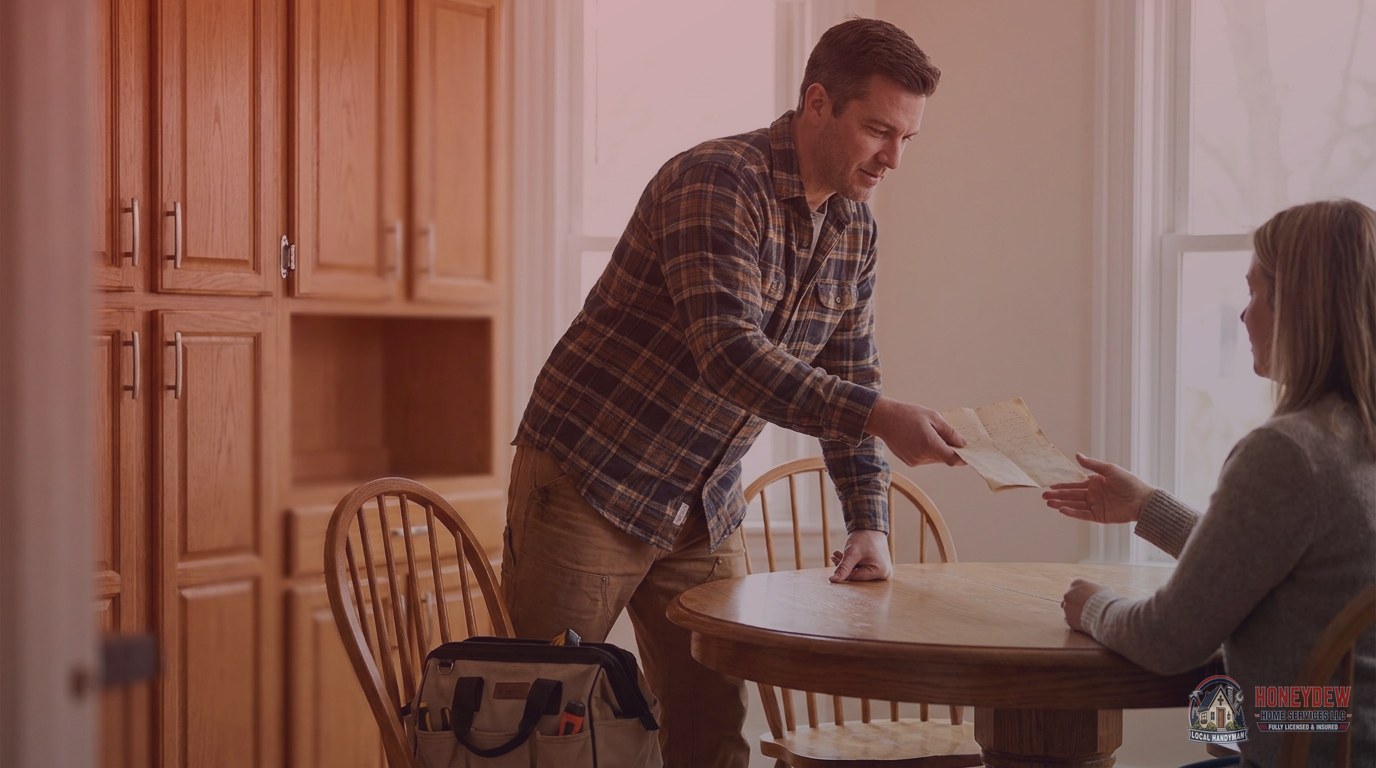
A written estimate details the scope of work, materials, and labor before any job starts. A written estimate and scope of work protects McDonough homeowners from scope creep, hidden fees, and incomplete repairs. Verbal quotes create disputes. Each party remembers a different conversation, and the homeowner usually loses.
A clear timeline names a start date and a realistic completion window. A handyman who commits to dates in writing gives the homeowner a standard to hold the project against when weather, materials, or other jobs cause delays.
Be cautious of any handyman who asks for more than 30 to 50 percent upfront. Georgia sets no statutory cap on deposit amounts for handyman work, so a large upfront payment with no written contract is a common fraud pattern in fast-growing suburban markets like McDonough.
A lien waiver upon completion is the step most homeowners skip, and it carries real legal weight. Under Georgia’s Mechanics’ and Materialmen’s Lien Statutes, an unpaid subcontractor or supplier the handyman hired can file a materialman’s lien against the homeowner’s property even when the homeowner already paid the handyman in full, according to GeorgiaLegalAid.org. A 2019 Bouhan Falligant analysis confirms the owner can end up paying twice for the same labor and materials. A signed lien waiver closes that exposure.
Warranty or guarantee terms belong in writing, never assumed. The document should state what the handyman guarantees, for how long, and how the homeowner requests a fix.
Honeydew Home Services provides written estimates, timelines, lien waivers, and warranty terms on handyman projects across McDonough and Henry County.
Why do McDonough homeowners choose Honeydew Home Services?
McDonough homeowners choose Honeydew Home Services because the company is licensed and insured for residential handyman work in Henry County, knows McDonough’s housing stock and local permit requirements, holds documented reviews from Henry County homeowners, and provides one point of contact without subcontracting.
Honeydew Home Services serves McDonough and the broader Henry County area as a licensed, insured residential handyman. Being licensed and insured protects the homeowner’s property and finances if something goes wrong during a repair, and it holds the company accountable to state and county standards.
The company works across McDonough’s mix of established neighborhoods near the downtown square and newer subdivisions, so Kenny Neville recognizes the repair patterns common to each type of housing stock. Honeydew Home Services also knows which projects trigger Henry County permit requirements and confirms permit status before work begins.
Homeowners can verify documented reviews from Henry County customers and request local references before hiring. Neighbors vouch for neighbors here.
The homeowner communicates with one point of contact from the first estimate through the final walkthrough. Honeydew Home Services does not hand jobs off to subcontractors, so the person who quotes the work is the person who does the work.
Sources
- Point2Homes, “McDonough, GA Demographics: Population, Income, and More”
- Georgia Public Policy Foundation, “Short Supply: How Many More Houses Does Georgia Need?” (2025)
- Henry County, Georgia, “Henry County, Georgia 2025 – 2029 Consolidated Plan & 2025 Annual Action Plan” (2025)
- USA Trade License, “Georgia Handyman Business Rules: The $2,500 Limit Explained (2026)” (2026)
- Next Insurance, “Handyman license requirements by state: A comprehensive guide” (2025)
- Justia / Georgia General Assembly, “Georgia Code § 43-41-17 (2024) – Effective date of licensing and sanctioning provisions; unenforceable contracts” (2024)
- Georgia Secretary of State, “State Licensing Board for Residential and Commercial General Contractors”
- Bouhan Falligant, “Subcontractors and Suppliers Should Exercise Their Lien Rights to Ensure Payment on a Construction Project” (2019)